
Key Highlights
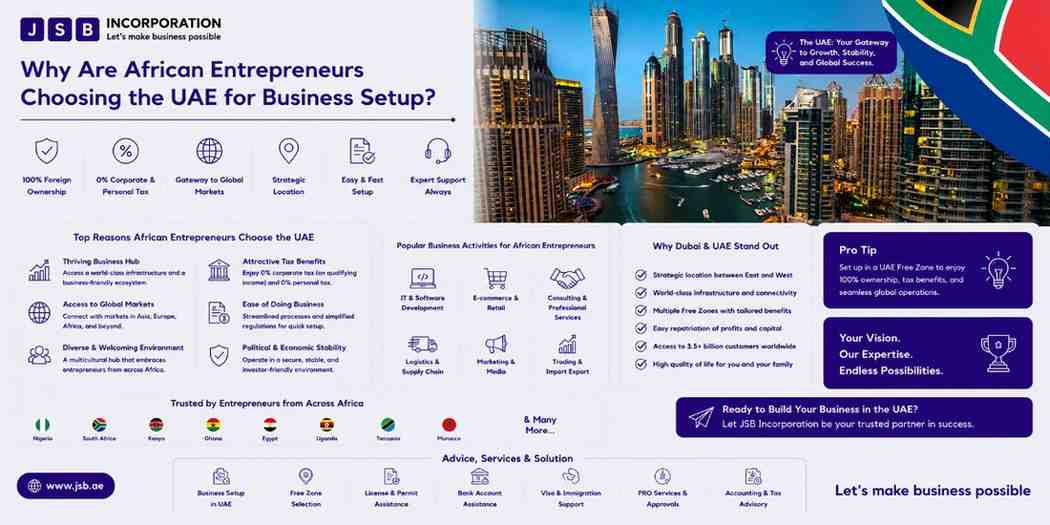
You get full foreign ownership, a stable currency peg, and direct air and shipping links to major African trade hubs.
The UAE’s non-oil foreign trade reached about AED 3.8 trillion in 2025, and African markets are a growing share of that activity, according to the Ministry of Foreign Trade.
That scale gives your business real customers to reach from day one.
After all, keep reading the article to learn more about setting up your business in the UAE.
Your choice depends on whether you plan to sell to mainland UAE customers or focus on international and free zone trade.
Mainland companies can trade anywhere in the UAE without restriction, while free zone companies need a mainland branch, distributor, or dual licence to reach mainland clients directly, per the official UAE government portal.
Factor | Mainland Company | Free Zone Company |
Foreign ownership | Up to 100% for most activities | 100% standard |
Mainland market access | Direct, no restrictions | Requires branch, distributor, or dual license |
Visa allocation | Tied to office size | Often bundled with a license package |
Setup cost range | Starting from AED 15,000 | Starting from AED 12,500 |
Best fit for African trade | Import, distribution, retail | Re-export, logistics, consulting, e-commerce |
Also Read:
Mainland vs. Free Zone for Startups: What’s Best for Business Setup in Dubai, UAE?
Mainland vs. Free Zone vs. Offshore: Best Business Setup Options for Europeans in UAE
You can register as a mainland limited liability company (LLC), a free zone establishment (FZE) or free zone company (FZC), a branch of a foreign company, or, in specific jurisdictions, an offshore company.
Federal Decree-Law No. 32 of 2021 on Commercial Companies, together with the 2020 ownership reform, now permits full foreign ownership of most mainland activities.
Yes. You can complete most of the registration process through a power of attorney and digital document submission and only need to travel for specific steps like biometric Emirates ID capture or in-person bank KYC.
JSB coordinates the paperwork so you are not required to be physically present for every stage.
“We have recently incorporated our company through JSB Incorporation. Gaurav Keswani has been a tremendous help throughout the entire process. His support enabled us to complete everything seamlessly, even accommodating last-minute changes. It was a wonderful experience working with JSB Incorporation. We look forward to a long-term engagement.” (Veena Talegaonkar, Google Reviews)
You’ll need identity, business, and attestation documents, and African-issued papers usually require legalization through your home country’s Ministry of Foreign Affairs and the UAE embassy before submission.
Requirements vary slightly by jurisdiction, so confirm the exact list with your chosen free zone or the Department of Economy and Tourism (DET).
Costs depend on your jurisdiction, licence activity, and visa quota and range from a few thousand AED for a basic free zone licence to significantly more for a mainland company with several visas.
Treat every published figure as a starting point, since free zones and government authorities revise pricing throughout the year.
Licence type | Starting price (AED) | Typical visa allocation | Renewal note |
Free zone licence (basic) | Starting from AED 12,500 | 1–2 | Annual, activity-dependent |
Free zone licence (multi-activity) | Starting from AED 20,000 | 2–6 | Annual, package-dependent |
Mainland LLC licence | Starting from AED 15,000 | Based on office size | Annual, office lease-linked |
Mainland branch of foreign company | Starting from AED 18,000 | Based on office size | Annual |
DMCC, JAFZA, RAKEZ, and IFZA each offer distinct advantages depending on your trade route and budget. Confirm each free zone’s current activity scope directly with its authority, since permitted activities and fees change over time.
You can qualify through two main routes relevant to entrepreneurs for the UAE Golden Visa: a public investment or property route requiring a minimum of AED 2,000,000 or an entrepreneur route requiring an approved business project valued at AED 500,000.
Both routes are confirmed on the Federal Authority for Identity, Citizenship, Customs, and Port Security’s Golden Residency page.
Route | Minimum requirement | Residency duration |
Public investment or real estate | AED 2,000,000 | 10 years (public investment) or 5 years (real estate) |
Entrepreneur | Auditor-certified project value of AED 500,000, plus an innovation or incubator approval letter | 5 years |
“Right now, the government has been very actively offering golden visa services to the right mindset. So if anyone happens to know they would be able to qualify across, please reach out to the immigration office. This is a very good time for you, where you would be able to obtain it either for yourself or for someone whom you know.” (Gaurav Keswani, Founder, JSB Incorporation, Talk 100.3 FM)
“Gaurav and team supported me from the start to the end to complete my residency. It was a seamless and efficient process. Highly recommend working with JSB.” (Nikhil M, Google Reviews)
Federal Decree-Law No. 20 of 2025 amended the Commercial Companies Law to formalize how free zone companies can operate onshore.
The Ministry of Economy and Tourism confirmed the amendment allows companies in free zones and financial free zones to conduct activities within the mainland through branches or representative offices.
It also allows companies to transfer their commercial registration between emirates or between free zones and the mainland without liquidation.
This matters if you’re considering starting in a free zone and later expanding into mainland UAE. You no longer need to dissolve your original company to make that move under the amended framework.
You’ll need a valid UAE trade license, company incorporation documents, and clear evidence of your source of funds, and banks apply enhanced checks for non-resident applicants.
Requirements differ by bank for corporate bank accounts, so JSB matches you with institutions suited to your business activity and transaction volume.
Banks follow Know Your Customer (KYC) and anti-money laundering (AML) procedures under Central Bank of the UAE (CBUAE) regulatory guidance, so keep your documentation consistent and complete before you apply.
Yes. Most mainland activities and all standard free zone company types allow full foreign ownership under the UAE’s ownership reform.
A limited list of strategic activities still requires additional approvals, so confirm your specific activity before you register.
2. Do I need to visit the UAE in person to register a company?
Not for most of the process. You can sign documents remotely through a power of attorney, though Emirates ID biometrics and some bank KYC steps typically require at least one visit.
3. Is a local UAE sponsor required for mainland companies?
No, not for most activities. The 2020 ownership reform removed the requirement for a majority Emirati shareholder for the large majority of mainland business activities.
4. Can I convert my free zone company to a mainland company later?
Yes. Federal Decree-Law No. 20 of 2025 introduced provisions allowing companies to transfer their registration between free zones and the mainland without liquidation.
5. What is the minimum investment for a UAE Golden Visa as a business owner?
You can qualify through a public investment or property route requiring AED 2,000,000, or an entrepreneur route requiring an auditor-certified project value of AED 500,000, per ICP’s Golden Residency page.
6. How long does it take to get a UAE trade license?
Timelines vary by jurisdiction and activity, and most straightforward free zone licences are issued within a few working days once documents are complete. Mainland licences can take longer if your activity needs additional government approvals.
7. Do African entrepreneurs pay corporate tax on UAE company profits?
Yes, on profits above the threshold. The Federal Tax Authority applies 0% on taxable income up to AED 375,000 and 9% on taxable income above that amount, per its Corporate Tax General Guide.
8. Can a UAE free zone company sell directly to UAE mainland clients?
Not directly. A free zone company must work through a licensed mainland distributor or establish a mainland branch or dual licence to sell to mainland customers, per the official UAE government portal
Reviewed by: Gaurav Keswani, Founder, JSB Incorporation
Gaurav Keswani is the Founder of JSB Incorporation, a Dubai-based business setup and immigration consultancy. He appeared on Talk 100.3 FM answering live listener questions on UAE Golden Visa eligibility, citing GDRFA and ICP guidelines directly on air. JSB Incorporation handles documentation preparation and application coordination; all visa and license decisions rest with the relevant UAE government authorities—GDRFA, ICP, DET, and DLD.
You don’t have to navigate mainland versus free zone rules, document attestation, or Golden Visa eligibility alone.
JSB Incorporation’s team handles the structuring advice, documentation, government submissions, and banking introductions so you can focus on running your business.
Whether you’re setting up a trading company to serve African markets, a consulting practice, or exploring the AED 500,000 entrepreneur Golden Visa route alongside your company formation, JSB coordinates the process from your current location through to your UAE trade licence and residence visa.

Office 2505, 25th Floor, Regal Tower, Business Bay, Dubai, UAE P.O Box 27614.
+971 4 824 4842
info@jsbincorporation.com
