
 Gaurav Keswani
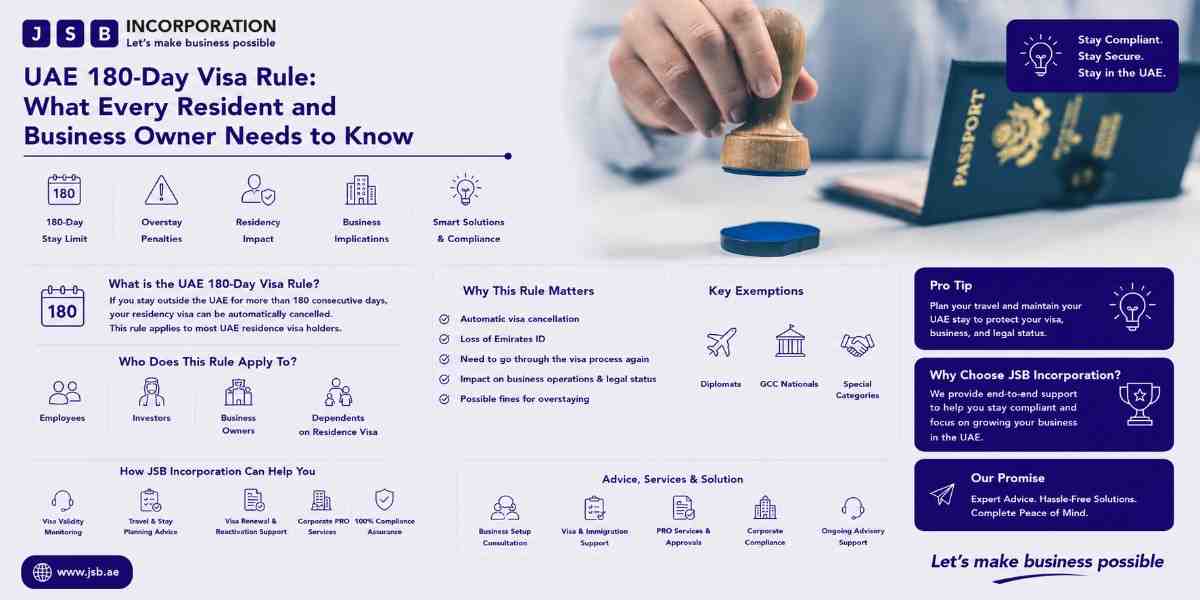
Key highlights
If you are a UAE resident planning an extended trip abroad, there is one number you cannot afford to ignore: 180.
Spend more than 180 continuous days outside the country, and your residence visa is automatically nullified under UAE government guidance, with no warning issued beforehand.
For business owners who travel frequently, employees stationed overseas, or families managing long stays abroad, understanding this rule is not optional. It is essential.
This guide breaks down exactly how the rule works, who is exempt, what it costs to fix a lapse, and the steps residents need to follow to stay compliant.
The rule is built around one concept: continuous absence. The restriction is measured through an unbroken stretch of time spent outside the country, not the total number of days accumulated across multiple trips.
This distinction matters. If you travel frequently but return to the UAE between trips, those separate absences do not add up against you. The 180-day clock only starts counting once you leave and does not return.
A standard residence visa holder who remains abroad beyond that continuous 180-day mark faces automatic invalidation of their residence status, triggered the moment the threshold is crossed rather than after any manual review.
For business owners with international travel schedules, family members living overseas for extended periods, or anyone managing long-term assignments outside the UAE, tracking the exact date of last departure becomes critical.
Residents who do cross the threshold are not automatically locked out for good. ICP operates a dedicated return permit process for exactly this situation.
To qualify for this permit, applicants need to meet a few specific conditions:
Applications only become available once the resident has actually completed 180 days abroad.
Employers can also play a role here. Establishment-sponsored residents can submit the request directly, and their sponsoring establishment has the option to lodge it on their behalf as well.
The entire process runs through ICP’s Smart Services platform, accessible via its website and mobile application, with UAE Pass used for identity verification. Once submitted, ICP typically processes these requests within two working days.
Getting the return permit approved is only half the job. Once ICP grants approval, residents face a strict 30-day window to physically re-enter the UAE, counting from the approval date itself.
Missing this window does not simply extend the deadline. It creates a fresh immigration status issue that requires renewed verification before the resident can travel back into the country. Approval is not a permanent green light. It is a time-bound opportunity that needs to be acted on quickly.
The fees attached to this process scale directly with how long a resident stayed away. ICP charges AED100, roughly $27, for every 30-day block spent abroad beyond the 180-day threshold. On top of that, a separate AED100 Smart Services processing fee applies to the application itself.
This means the financial cost of an extended absence grows the longer someone stays away. For residents planning long-term travel, this makes it worthwhile to plan the return date carefully rather than treating the 180-day mark as a flexible guideline.
Residents cannot access this ICP service before actually completing 180 days abroad, and their existing residence permit needs more than 30 days of validity remaining at the time of application.
Residents whose permits have already expired will need a different immigration route entirely, since this permit service does not apply to expired residency.
Not every residence category falls under this restriction. The following groups remain exempt from the 180-day rule as long as their underlying residence status stays valid:
Residents should verify the exemption status attached to their specific visa type rather than assuming the standard 180-day calculation automatically applies to them, since eligibility depends on the exact category their residence falls under.
Here is a detail that catches many residents off guard: this entire ICP process does not apply to Dubai-issued residence visas. ICP explicitly excludes Dubai residents from its return permit process for absences beyond six months.
Instead, Dubai-issued visa holders fall under a separate administrative system managed by GDRFA. This authority manages Dubai residence matters through its own digital channels and Amer services centers.
If your residence visa was issued in Dubai and you have spent more than six months outside the UAE, GDRFA, not ICP, is where you need to verify your immigration file before making any travel arrangements.
Given the fees, the strict deadlines, and the split between two separate government systems depending on where your visa was issued, a few practical habits go a long way toward avoiding complications:
For entrepreneurs and business owners operating in the UAE, this rule carries direct operational weight.
A lapsed residence visa can disrupt banking access, business licensing renewals, and day-to-day operations that depend on valid residency. Founders who travel extensively for supplier meetings, international expansion, or family reasons need a system in place to track absence periods accurately.
The safest approach is treating the 180-day threshold as a hard deadline rather than a flexible guideline.
Building a simple tracking habit, noting your UAE departure date every time you travel, removes the guesswork and protects your residence status well before it becomes a compliance issue.
If your business setup plans involve frequent international travel, factoring this rule into your operational planning from day one can save considerable time, cost, and administrative friction down the line.

Office 2505, 25th Floor, Regal Tower, Business Bay, Dubai, UAE P.O Box 27614.
+971 4 824 4842
info@jsbincorporation.com