
Quick Summary
A coworking operator needs a commercial or professional trade licence covering business center or shared workspace activity.
Dubai’s Department of Economy and Tourism (DET) issues this licence for mainland operators, while a free zone authority issues it for free zone operators.
The exact activity classification and its code differ by jurisdiction, so confirm the naming convention at the application stage rather than assume it matches another emirate or free zone.
The two licensing routes work quite differently in practice:
JSB helps confirm the correct activity name and code with the licensing authority before you file, so you don’t get stuck mid-application over a wrong classification.
After all, keep reading the article to learn more.
Mainland licensing under DET lets you lease standalone commercial premises and serve clients anywhere in the UAE.
Free zone licensing under the relevant free zone authority offers up to 100% foreign ownership but generally keeps your client base inside that zone or with other free zone entities.
The right fit depends on where your target tenants are based and where you plan to lease your premises.
Both mainland and free zone companies in the UAE can now be 100% foreign-owned for most commercial activities.
This position was established after the 2021 amendments to the Commercial Companies Law and remains ongoing government policy rather than a new 2026 change.
Ownership is rarely the deciding factor anymore; the real decision comes down to your client base and premises location.
Factor | Mainland (DET) | Free Zone |
Ownership structure | Up to 100% foreign ownership for most activities | Up to 100% foreign ownership |
Permitted client base | Anywhere in the UAE | Primarily within the free zone, unless using a branch pathway |
Typical premises location | Any commercial building across Dubai | Within the designated free zone |
Visa allocation approach | Tied to office size and activity | Tied to package tier and desk or office allocation |
Best-fit operator profile | Coworking spaces targeting mainland companies and walk-in clients | Coworking spaces targeting free zone startups and freelancers |
If you’re weighing the mainland against the free zone for reasons beyond coworking specifically, JSB’s mainland company formation and free zone business setup teams can map your target tenant profile against both routes before you commit to a lease.
Free zone licence pricing is typically structured in tiers based on visa allocation, such as zero-visa or multi-visa packages, and these packages are frequently bundled with promotional extras like a complimentary flexi-desk for the first year.
These figures change often and are tied to specific promotional windows, so request the current live price list from your chosen free zone partner rather than relying on a number you saw months ago.
Free zone packages generally break down into three tiers:
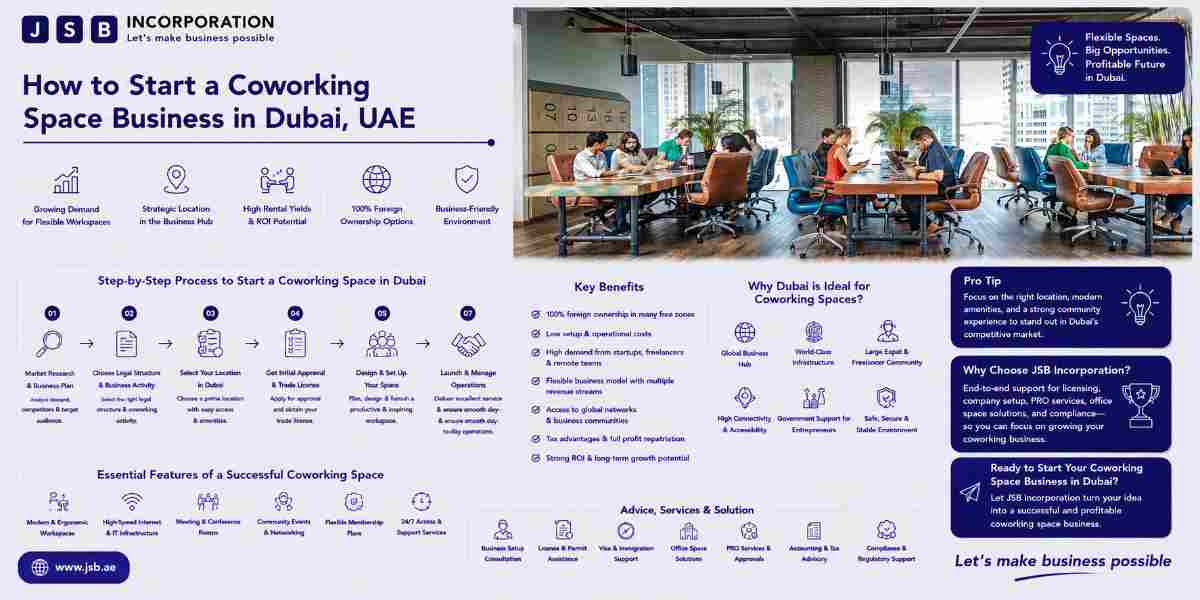
Setting up a coworking business generally follows activity selection, jurisdiction choice, trade name reservation, initial approval, securing a registered commercial lease, and completing fit-out and safety approvals before your final licence is issued.
The exact sequence and approving authority differ depending on whether you choose mainland or free zone.
For a mainland coworking business, the setup sequence works like this:
For a free zone coworking business, the general sequence runs:
Setting up your coworking business the right way from day one matters, and clients consistently mention this in their reviews. As one Google review puts it: “What a fabulous service by Gaurav. He literally solved our problems for opening a company in UAE. Has a professional team to assist. Amazing customer service. High recommended for company formation. He also assisted us with banking services. Thank you once again.” Dhaval Shah, Google Reviews.
Expect to prepare shareholder identification documents, trade name reservation confirmation, your company’s constitutional documents such as the Memorandum of Association (MOA) where applicable, a registered tenancy contract, and any authority-specific sub-leasing or fit-out permission before your licence is finalized.
Exact document lists vary between mainland and free zone jurisdictions, so treat this as a general checklist rather than a fixed list.
At minimum, plan to gather:
Because a coworking model involves subletting portions of a leased property to third parties, confirm with your landlord and licensing authority whether explicit written subleasing permission is required before you finalize your tenancy contract and licence.
This is a frequently overlooked step that can delay your approval if you skip it. Treat this as a case-by-case check with your specific landlord and authority rather than a fixed rule that applies uniformly across every building or jurisdiction.
Beyond your base trade license, premises used for shared office operations may require additional civil-defense, fire-safety, and municipal fit-out approvals before you can open to the public.
Exact requirements depend on your building, jurisdiction, and licensing authority, so don’t assume every coworking premise needs the identical approval stack.
Categories of approval you should plan to confirm include:
The Federal Tax Authority sets the mandatory VAT registration threshold at AED 375,000 in taxable supplies and imports.
A coworking operator renting out desks and offices is providing a taxable supply, so this threshold applies once your revenue crosses that mark.
Most mainland and free zone business licence packages include an investor or partner residence visa allocation tied to office size or package tier, with additional employee visas available as your business grows.
Exact visa quotas are set by the licensing authority and by current immigration rules at the time of your application. Don’t confuse this standard investor residence visa with the UAE Golden Visa, since the two serve different eligibility tracks entirely.
The UAE Golden Visa is a separate, longer-term residence track. The investor category grants 10-year residence for public investments of at least AED 2 million, or 5-year residence for real estate investments meeting the same AED 2 million threshold.
A coworking operator only qualifies for this route if they separately meet the published investment criteria, not simply by holding a standard trade licence. Costs and regulations are subject to change.
Yes, but you need to confirm subleasing permission with both your landlord and your licensing authority before finalizing your tenancy contract.
This requirement varies by building and jurisdiction, so treat it as a case-by-case verification rather than an assumption.
Skipping this step is one of the most common causes of delayed licence approval for coworking operators.
2. Can a foreigner own 100% of a coworking space company in Dubai?
Yes, for most commercial activities, both mainland companies under DET and free zone companies allow up to 100% foreign ownership.
A small number of regulated or strategic activities may still carry additional ownership conditions, so confirm your specific activity’s status at the application stage.
3. What is the difference between a mainland and a free zone coworking license?
A mainland licence from DET lets you serve clients anywhere in the UAE and lease standalone commercial premises, while a free zone licence generally restricts your client base to within that zone.
Your choice should depend on where your target coworking tenants are based, not on ownership rules alone.
4. Do coworking space operators need to register for VAT?
Yes, the Federal Tax Authority sets the mandatory VAT registration threshold at AED 375,000 in taxable supplies and imports. Renting out desks and offices counts as a taxable supply for this purpose.
5. How long does it typically take to get a coworking space licence approved?
Processing time depends on your jurisdiction, activity approvals, and whether your premises need additional fit-out or civil-defense clearance.
Mainland and free zone authorities publish their own standard processing windows, so confirm current timelines directly with your chosen authority before planning your launch date.
6. Can a free zone coworking licence serve mainland-based clients?
Generally, free zone licences restrict you to operating within that free zone or with other free zone entities, though newer branch registration pathways in some cases allow limited mainland activity.
7. What visa allocation comes with a coworking business license?
Most business licence packages include an investor or partner residence visa tied to your office size or package tier, with room to add employee visas as you scale.
This is separate from the UAE Golden Visa, which requires meeting its own investment threshold independently.
8. What approvals are needed before a coworking space can open to the public?
Beyond your trade license, you’ll likely need civil-defense fire-safety clearance and municipal fit-out approval for shared-occupancy premises.
Exact requirements depend on your building and licensing authority, so confirm the applicable approval list with your authority before you schedule your opening date.
Reviewed by: Gaurav Keswani, Founder, JSB Incorporation
Gaurav Keswani is the Founder of JSB Incorporation, a Dubai-based business setup and immigration consultancy. He appeared on Talk 100.3 FM answering live listener questions on UAE Golden Visa eligibility, citing GDRFA and ICP guidelines directly on air. JSB Incorporation handles documentation preparation and application coordination; all visa and license decisions rest with the relevant UAE government authorities, GDRFA, ICP, DET, and DLD.
Compare mainland versus free zone licensing for your coworking space and get a structured setup plan built around your target tenant base, premises location, and visa needs.
JSB Incorporation’s team handles activity classification, jurisdiction comparison, document preparation, and PRO coordination for approvals, so you spend your time building your coworking business instead of chasing government portals.
Book your free consultation call today with the experts of JSB Incorporation to learn more.

Office 2505, 25th Floor, Regal Tower, Business Bay, Dubai, UAE P.O Box 27614.
+971 4 824 4842
info@jsbincorporation.com
