
 Gaurav Keswani
Key Highlights
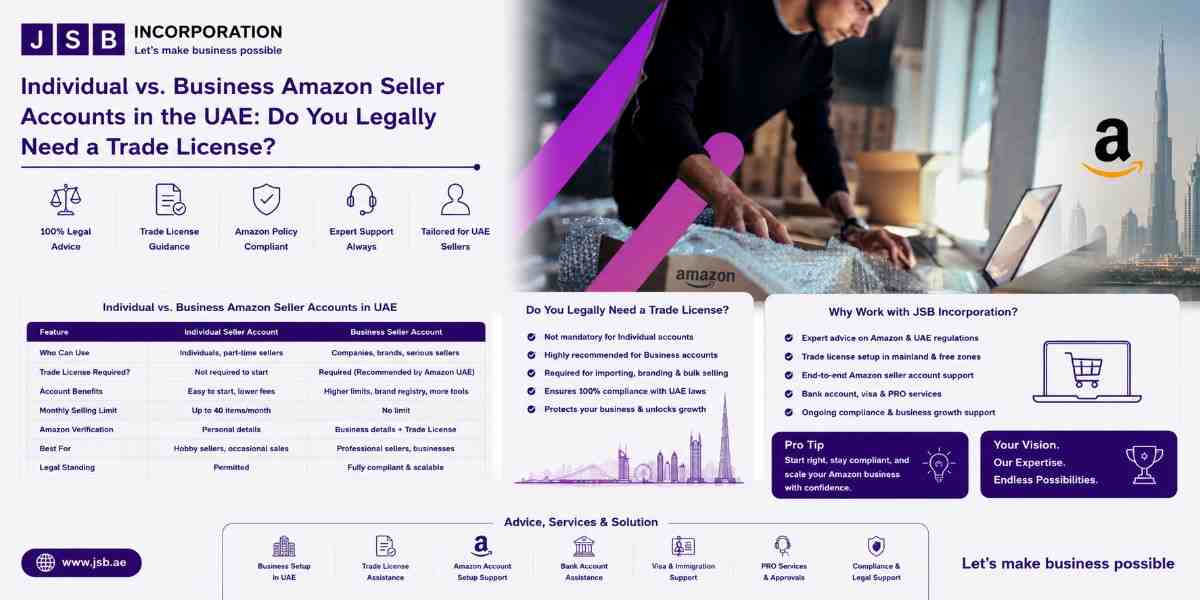
Yes, you need a UAE trade license to sell on Amazon.ae, regardless of whether your Seller Central account is registered as Individual or Professional.
This isn’t an Amazon-specific rule you can work around, it’s a requirement under UAE federal commercial law, and Amazon’s own policy simply enforces it.
Keep reading the article if you are confused about individual and business amazon sellers.
The UAE e-commerce market reached an estimated USD 12.30 billion in 2026 and is projected to grow to USD 21.01 billion by 2031, expanding at an 11.29 percent compound annual rate.
Within that market, Dubai alone claimed roughly 60 percent of total UAE e-commerce activity in 2025, supported by 90 percent internet penetration across its 3.6 million residents and more than 100 fulfillment centers citywide.
As more individual sellers try to capture a share of that growth, regulators and marketplaces both have a stronger incentive to enforce licensing consistently rather than looking the other way on small accounts.
That’s precisely why resolving this compliance question correctly now matters more than it did even a year or two ago, before enforcement scaled up alongside the market itself.
UAE law requires anyone conducting commercial activity, including online trade, to hold a valid trade license issued by the relevant Emirate’s Department of Economic Development.
The standard mainland business setup process involves nine steps: identifying your business activity, selecting a legal form, applying for a trade license, registering your trade name, getting initial approval, signing a Memorandum of Association, selecting a business location, securing additional government approvals, and submitting your documents with fees.
This obligation exists at the federal and emirate levels, independent of whatever platform you sell through. The requirement to hold a license doesn’t come from Amazon; it comes from UAE commercial law itself, and Amazon is simply the marketplace enforcing it on its end.
There are six license categories at the federal level: industrial, commercial, professional, tourism, agricultural, and crafts. Dubai’s own Invest in Dubai platform lists eight license types locally, including the eTrader license built specifically for home-based sellers.
None of these categories include a quantity-based or informal exemption for small or part-time sellers, which is worth repeating because it directly contradicts one of the most common forum claims.
No, the license requirement is identical for both account types. Amazon’s own official commercial license page states plainly that if your business is operating in the UAE, you need a valid commercial license, and this applies whether you operate from mainland UAE or a free zone.
That single sentence is the entire policy, and it makes no distinction between individual sellers and registered companies.
So why do so many sellers believe individual accounts are exempt? Amazon Seller Central’s account tiers, Individual and Professional, actually refer to a pricing and fee structure for listing products, not a legal exemption from UAE commercial law.
A seller can technically register for either account tier, but the government licensing requirement sits above that choice entirely.
Amazon’s page also specifies that you need a Commercial Registration if you own the account, or a Power of Attorney if you’re managing it on someone else’s behalf.
Nowhere on that page does it say the individual tier waives the licensing requirement. Sellers see two different account types on Amazon and assume one of them must come with lighter legal obligations, when in reality the licensing question is decided entirely by UAE law, not by which Seller Central tier you pick.
No, there is no unit-based exemption in any official UAE or Amazon source. This is the claim you’ve probably seen repeated across Reddit threads more than any other: sell under roughly 40 units a month, and you supposedly don’t need a license.
This number appears nowhere in official UAE guidance or in Amazon’s own licensing page. Neither the mainland business steps nor Amazon’s commercial license requirements mention any quantity-based threshold for exemption.
It’s an unverified community claim, not a rule from any regulator or from Amazon itself. Community threads tend to circulate because someone’s account genuinely wasn’t flagged yet, not because a formal exemption exists in writing anywhere.
Amazon’s verification checks aren’t necessarily triggered the moment you list your first product, they may happen later, during a compliance review, a payout hold, or a routine account audit.
If that happens and you don’t have a license on file, the absence of one so far isn’t proof you’re exempt. It just means enforcement hadn’t caught up yet, and treating a Reddit comment as a legal safe harbor is a risky bet against your own income stream, especially in a market growing as fast as the UAE’s.
Three license paths are directly referenced on Amazon’s own commercial license page: a mainland commercial license, a free zone e-commerce license, and Dubai’s DED eTrader license for home-based sellers.
The right one for you depends on where your customers are, your budget, and whether you plan to scale beyond a home-based operation.
License type | Typical cost | Who it suits | Sells to UAE customers directly |
Mainland commercial license | Varies by Emirate and business activity, issued via each Emirate’s Department of Economic Development | Residents and non-residents wanting full mainland trading rights | Yes |
Free zone e-commerce license (example: IFZA) | From AED 11,900 per year inclusive of VAT for a zero-visa business license, plus AED 2,000 for an Establishment Card | Founders wanting international trade, lower setup complexity, and optional visa allocation | Limited, generally scoped to the free zone and international trade |
DED eTrader license (Dubai) | AED 1,370, as published on Amazon’s own licensing page | UAE residents running a home-based online business in Dubai | Yes, within Dubai |
Amazon’s page specifically calls out the eTrader license as one of the lowest-cost options available through Dubai’s Invest in Dubai platform, largely because it allows online selling as a registered economic activity.
If you’re a Dubai resident selling from home and don’t need a physical office or an import and export operation, this is usually the cheapest legitimate path onto the platform.
If you’re building an actual e-commerce brand with warehousing, multiple product lines, or plans to bring on staff, a free zone commercial license gives you more room to grow.
As one illustration, IFZA’s 2026 published pricing puts its Zero Visa Business License starting at AED 11,900 per year inclusive of VAT, with an Establishment Card fee of AED 2,000 charged separately and not covered under the standard package.
Multi-year packages carry built-in discounts of up to 30 percent for five-year terms, and additional visa allocations raise the price incrementally, so it’s worth mapping your setup against your actual growth plans before committing to a package.
Not automatically. Free zone licenses are generally scoped to activities within the free zone itself and to international trade, not necessarily to direct retail sales to mainland UAE customers.
If your goal is to sell to shoppers browsing Amazon.ae from Dubai, Abu Dhabi, or Sharjah, a free zone license alone may not automatically cover that mainland distribution channel.
In practice, this means some free zone sellers pair their setup with a mainland distribution arrangement to legally reach local customers, rather than relying on the free zone license by itself.
Before choosing a free zone purely because it looks cheaper on paper, map out exactly where your customers are located and whether your intended license scope actually covers that trade.
For a broader comparison across UAE free zones, the Ministry of Economy and Tourism maintains an official directory covering how businesses are established across free zones nationwide, which is the current government-maintained resource for checking activity permissions and jurisdiction-specific rules.
Amazon’s own commercial license page points sellers to this same ministry resource when explaining free zone licensing options, underscoring that this is the government’s own recommended reference point.
You upload your license through the Business Information tab in your Seller Central account settings. According to Amazon’s own documentation, the path is:
Amazon reviews the document as part of its standard identity verification process. If your license details, like your registered business name or activity, don’t match your Seller Central profile exactly, expect a request for clarification before approval goes through.
Keeping your license, trade name, and Amazon account information consistent from the start saves you a back and forth cycle later, and it reduces the odds of a payout hold while the mismatch gets sorted out.
Yes. UAE commercial law requires a license for anyone conducting business activity, including online trade, and Amazon’s own policy confirms this applies whether you operate on the mainland or in a free zone. The Individual account type on Seller Central relates to fee structure, not legal exemption.
2. Is there really a 40-unit limit before I need a license?
No official source, neither UAE government guidance nor Amazon’s commercial license page, mentions any unit-based exemption threshold. Treat this as an unverified claim circulating in seller communities, not a documented rule.
3. What’s the cheapest license accepted by Amazon?
For Dubai residents running a home-based online business, the DED eTrader license is the lowest-cost option cited directly by Amazon, priced at AED 1,370.
4. Can I use a free zone license to sell on Amazon.ae to UAE customers?
Free zone licenses are typically scoped to the free zone and international trade, so selling directly to mainland UAE customers may require an additional mainland distribution arrangement alongside your free zone setup.
5. Where do I upload my license on my existing Amazon Seller Central account?
Go to Account Information, then Business Information, then Identity Information, and upload your license there for Amazon’s verification team to review.
Disclaimer: License fees, government charges, and market figures referenced above are current as of publication and drawn from official UAE government sources, Amazon’s own licensing page, and third-party market research. Fees and market conditions change periodically, so confirm current pricing directly with the relevant Department of Economic Development, free zone authority, or Amazon’s Seller Central help pages before budgeting or applying.
Chasing conflicting advice costs you time you don’t have, and getting it wrong risks an account suspension right when your listings are gaining traction in a fast-growing market.
JSB Incorporation helps entrepreneurs navigate exactly this kind of two-layer compliance question, matching the right UAE license type, mainland, free zone, or e-trader, to how you actually plan to sell, with transparent pricing and no guesswork.
From trade license setup to bank account opening and ongoing compliance support, the goal is getting you legally selling in weeks, not months.
Book your free consultation call today with the experts of JSB Incorporation to learn more.

Office 2505, 25th Floor, Regal Tower, Business Bay, Dubai, UAE P.O Box 27614.
+971 4 824 4842
info@jsbincorporation.com