
Key Highlights
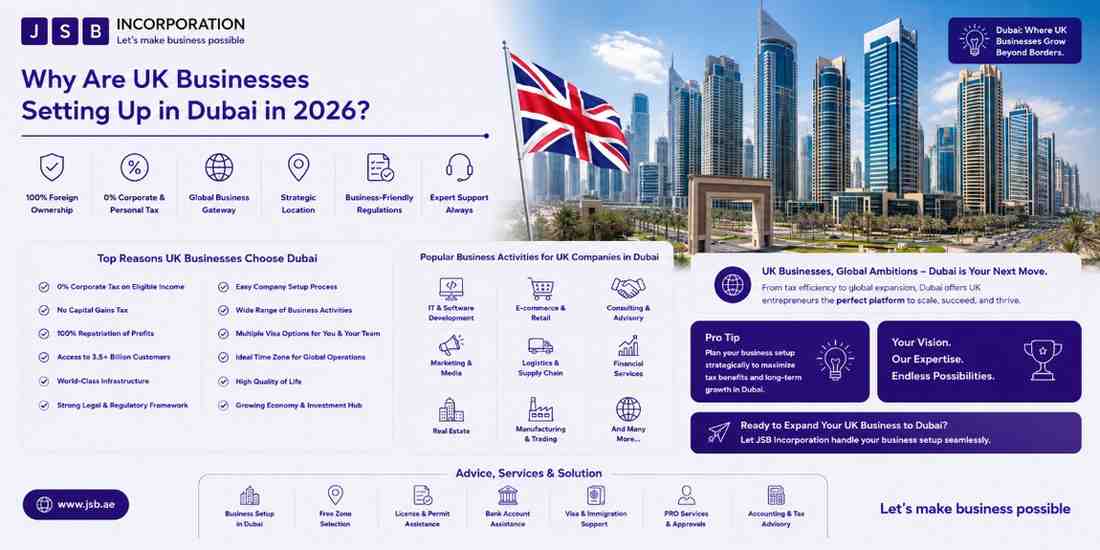
UK companies are setting up in Dubai in 2026 for three main reasons: 0% personal income tax, 100% foreign ownership across most activities, and strong UK-UAE trade ties.
Total trade in goods and services between the UK and the UAE reached £25.0 billion in the four quarters to Q4 2025, up 3.7% year on year, per the UK Department for Business and Trade’s trade and investment factsheet.
That trade relationship gives UK founders an existing commercial bridge. Many UK-owned businesses in Dubai serve UK and European clients remotely while using the emirate as a base for regional growth.
Keep reading to learn more.
Yes, UK citizens can own 100% of most mainland businesses and all free zone businesses in Dubai.
This followed Federal Decree-Law No. 26 of 2020, which amended the UAE Commercial Companies Law to remove the previous requirement for a UAE national to hold at least 51% of most mainland companies.
A limited list of activities still falls outside full foreign ownership, generally covering security-linked, strategic, and certain regulated financial services activities.
The right structure depends on whether your business needs direct UAE mainland market access or mainly serves international clients remotely.
Mainland companies can trade UAE-wide and bid on government contracts; free zone companies are built for international trade, with mainland access typically needing a distributor or dual licence.
Feature | Mainland | Free Zone |
Foreign ownership | Up to 100% for most activities | 100% for all activities |
Market access | Direct UAE-wide trading, government contracts | International trade, limited direct mainland access |
Office requirement | Physical office with Ejari registration | Flexi-desk or physical office, depending on the zone |
Indicative setup cost | AED 15,000–50,000 | AED 12,000–34,000 |
Corporate tax treatment | 9% above AED 375,000 taxable income | 0% on qualifying income for Qualifying Free Zone Persons, subject to FTA conditions; 9% otherwise |
Typical UK use case | Retail, F&B, construction, direct UAE trading | Consulting, e-commerce, media, holding companies |
Not sure which structure fits your business model? A JSB structuring consultation walks through your activity, client base, and growth plan before you commit to a jurisdiction.
Also Read:
Mainland vs. Free Zone for Startups: What’s Best for Business Setup in Dubai, UAE?
Mainland vs. Free Zone vs. Offshore: Best Business Setup Options for Europeans in UAE
Registering a company in Dubai from the UK follows five core stages: activity selection, trade name reservation, jurisdiction application, document submission, and licence issuance. Much of this sequence can be initiated online before you set foot in the country.
Setup cost depends heavily on structure. Free zone packages generally start lower than mainland licenses, while offshore structures carry the lowest fees but the most limited scope.
Budget licence fees and office charges separately from visa costs, which vary by authority.
Structure | Licence Fee Range | Office/Desk | Visa Costs |
Mainland | AED 15,000–50,000 | Ejari office from AED 15,000/year | Confirm current per-visa fees with the relevant authority or JSB |
Free zone | AED 12,000–34,000 | From AED 15,000/year (flexi-desk options vary) | Confirm current per-visa fees with the relevant authority or JSB |
Professional/offshore licence | AED 10,000–18,000/year | Not required | Not applicable for most offshore structures |
“What a fabulous service by Gaurav. He literally solved our problems for opening a company in the UAE. Has a professional team to assist. Amazing customer service. High recommended for company formation. He also assisted us with banking services. Thank you once again.” (Dhaval Shah, Google Reviews)
You can handle most registration and ownership paperwork remotely through a power of attorney, but a few steps require your physical presence.
Can be done remotely: activity selection, trade name reservation, document preparation, Memorandum of Association signing through power of attorney, and most licence application stages.
Requires physical presence: Emirates ID biometrics, medical fitness testing for residence visa applicants, and, in most cases, opening a UAE business bank account since UAE Central Bank regulations require in-person verification for account applications.
Also Read: Is Remote Company Formation Possible in Dubai, UAE? (2026 Guide)
UAE corporate tax applies at 0% on taxable income up to AED 375,000 and 9% on income above that threshold, per the Federal Tax Authority. A 2016 UK-UAE Double Taxation Convention also exists to address cross-border tax treatment between the two countries.
Two further UAE-side changes take effect on 1 January 2026, per the Federal Tax Authority. Federal Decree-Law No. 17 of 2025 amends the Tax Procedures Law. Federal Decree-Law No. 16 of 2025 amends the VAT Law.
Together, the two decrees introduce a five-year limitation period for reclaiming credit balances and refundable VAT. A one-year transitional window applies to balances that expired just before the new rule took effect.
The amendments also let the Federal Tax Authority deny input tax deductions linked to evasion arrangements and let it issue directions binding on both taxpayers and the authority itself.
None of this addresses your personal UK tax position. If you remain a UK tax resident and keep management or control of your Dubai company in the UK, ask a UK tax adviser whether Controlled Foreign Company rules could bring UAE-sourced profits back into UK tax scope.
This is a UK domestic question outside UAE regulation, so it needs a UK-qualified adviser.
UK investors can qualify for the UAE Golden Visa through a property or business investment meeting the threshold set by the Federal Authority for Identity, Citizenship, Customs, and Port Security (ICP), typically AED 2,000,000.
The visa is valid for up to 10 years, doesn’t require a local sponsor, and doesn’t require re-entry every six months to stay valid.
Some emirates outside Dubai apply stricter payment-verification rules for jointly owned property, so a couple relying on a mortgage or payment plan should confirm directly with ICP or the relevant Land Department whether their paid-up amount, not the contract value, meets the threshold.
“JSB Incorporation was recommended to me by a friend and they helped me throughout the process of my Golden Visa application. I had a fabulous experience working with Gaurav and Beena for my Dubai Golden Visa application. The entire process was managed with impeccable professionalism, sound knowledge, transparency and sharp communication. A special shout-out to Gaurav, who went above and beyond at particularly the week I was in Dubai — extremely proactive, always responsive and alert with every single question I had. Overall, I would highly recommend JSB incorporation for any similar visa related advisory and support, or broadly on business setup assistance in the UAE.” (Rajnish Pal, Google Reviews)
No, most mainland and all free zone activities allow 100% foreign ownership since Federal Decree-Law No. 26 of 2020. A limited list of security-linked and strategic activities still requires Emirati participation.
2. How much does it cost to register a company in Dubai from the UK?
Free zone setup typically starts from AED 12,000 to AED 34,000 in year one, and mainland setup from AED 15,000 to AED 50,000 or more, excluding visa costs. Request a personalized quote before budgeting.
3. Is Dubai company income tax-free for UK owners?
UAE corporate tax is 0% on taxable income up to AED 375,000 and 9% above that, per the Federal Tax Authority. Whether you owe UK tax on the same income depends on your personal UK tax residency status, not the UAE rate alone.
4. Does UK Controlled Foreign Company legislation apply to a UAE company?
It can, if you remain UK tax resident and keep management or control of the company in the UK. This is a UK domestic tax question that a UK tax adviser needs to assess alongside your UAE structure.
5. How long does Dubai company registration take for a UK applicant?
Processing time varies by authority and activity, so confirm current timelines directly with the specific free zone or DET authority. Many straightforward free zone licences are issued within days once documents are complete.
6. Can I open a UAE business bank account without visiting Dubai?
Most UAE banks require in-person verification for corporate bank account applications, per UAE Central Bank regulations, so you’ll typically need at least one visit.
7. What is the minimum capital required to set up a company in Dubai?
Most mainland LLCs and free zone companies don’t set a fixed minimum share capital requirement, though this varies by activity and authority. Confirm your specific requirement before filing.
8. Can a UK business get a Golden Visa through a Dubai company?
Yes, business investment meeting the ICP-published threshold, typically AED 2,000,000, can qualify a UK founder for a 10-year Golden Visa. The visa doesn’t require a local sponsor and allows dependent sponsorship.
9. Is a UAE free zone company allowed to trade with UK clients?
Yes, free zone companies are commonly used for international trade, including serving UK clients remotely. Direct mainland trading from a free zone company typically requires a distributor or dual licence.
10. Do I still pay UK tax if my company is registered in Dubai?
It depends on your UK tax residency and where management and control of the company sits. The 2016 UK-UAE Double Taxation Convention addresses some cross-border treatment, but confirm your specific position with a UK tax adviser.
Reviewed by Gaurav Keswani, Founder, JSB Incorporation
Gaurav Keswani is the Founder of JSB Incorporation, a Dubai-based business setup and immigration consultancy. He appeared on Talk 100.3 FM answering live listener questions on UAE Golden Visa eligibility, citing GDRFA and ICP guidelines directly on air. JSB Incorporation handles documentation preparation and application coordination; all visa and license decisions rest with the relevant UAE government authorities—GDRFA, ICP, DET, and DLD.
If you’re weighing the mainland against a free zone, budgeting first-year costs, or checking whether your activity qualifies for 100% ownership, the fastest path forward is a direct conversation with someone who handles these filings daily.
JSB Incorporation’s team reviews your activity, structure, and timeline, then manages documentation and authority submissions on your behalf, including remote onboarding for UK-based founders who can’t travel immediately.
Whether your priority is a fast free zone setup, mainland market access, or a Golden Visa alongside your company formation, a short consultation clarifies your exact costs and next steps before you commit to a jurisdiction.
Book your free consultation call today with the experts of JSB Incorporation to learn more.

Office 2505, 25th Floor, Regal Tower, Business Bay, Dubai, UAE P.O Box 27614.
+971 4 824 4842
info@jsbincorporation.com
