
 Gaurav Keswani
Summary
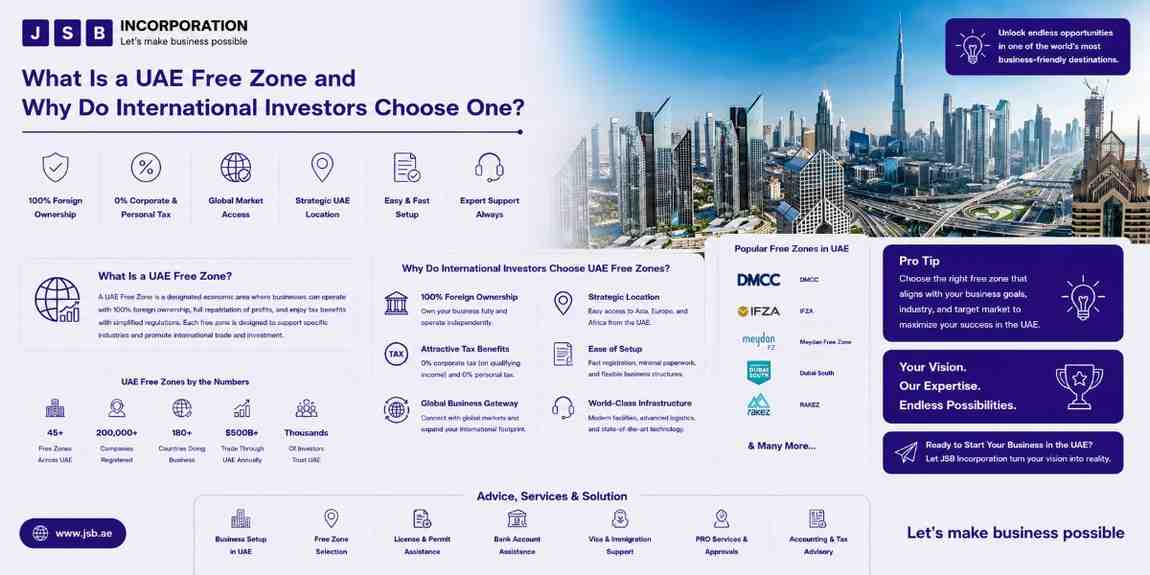
A UAE free zone is a designated economic area that offers 100% foreign ownership, tax exemptions, and its own regulatory authority, separate from mainland jurisdiction.
The UAE hosts more than 40 multidisciplinary free zones, according to the Ministry of Economy and Tourism (MOET). Investors choose free zones because they remove the ownership and administrative friction that once applied to onshore setup.
If you’re comparing options across Emirates, JSB advises on zone selection for company formation in more than 24 UAE jurisdictions, including DMCC, IFZA, and JAFZA.
Keep reading the article to learn more.
The best UAE free zone depends on your business activity rather than a single best answer.
Commodities and trading-focused investors typically choose JAFZA or DMCC. Cost-conscious multi-activity businesses lean toward IFZA, and regulated financial services firms look at DIFC or ADGM.
Free Zone | Best For | Ownership | Visa Allocation Flexibility | Relative Cost Tier | Emirate |
DMCC | Commodities, trading, holding/family office structures | 100% foreign | High, scales with office size | Mid to high | Dubai |
IFZA | Cost-efficient multi-activity consultancy | 100% foreign | Flexible, zero to 4+ visas per package | Low to mid | Dubai |
JAFZA | Industrial, logistics, large-scale trading | 100% foreign | High, tied to warehouse/office size | Mid to high | Dubai |
DMCC’s own Licensing Rules confirm five licence categories: Trading, Service, Commercial (for SPV, holding company, and family office structures), Industrial, and Freelance.
JAFZA’s own business activity resource page confirms it inherits its permitted-activity list directly from the Dubai Economic Department’s unified activities guide.
Free zones have always permitted 100% foreign ownership for FZE, FZ-LLC, and FZCO structures, with no local partner requirement at any point.
This differs from mainland UAE, where full foreign ownership became the general rule only after a 2021 reform.
Q: Is free zone ownership different from mainland ownership rules?
A: Yes. Free zone ownership has never required a local partner. Mainland ownership changed under Federal Decree-Law No. 26 of 2020, which removed the requirement for majority Emirati ownership for most mainland activities, according to the UAE government’s official portal.
Activities classified as having strategic impact still require additional approval on the mainland.
Free zone setup costs vary by visa allocation and licence term, with zero-visa, one-year IFZA licences starting from AED 11,900 inclusive of VAT.
This is commercial pricing that free zones set independently, so no government source publishes it.
Licence Type | 1-Year | 2-Year | 3-Year | 5-Year |
Zero Visa | AED 11,900 | AED 20,200 | AED 28,600 | AED 41,700 |
1 Visa | AED 14,900 | AED 25,300 | AED 35,800 | AED 52,200 |
2 Visa | AED 16,900 | AED 28,700 | AED 40,600 | AED 59,200 |
3 Visa | AED 18,900 | AED 32,100 | AED 45,400 | AED 66,200 |
4+ Visa | AED 20,900 | AED 35,500 | AED 50,200 | AED 73,200 |
Costs and regulations are subject to change. Confirm current figures with the relevant UAE government authority or with JSB before making decisions.
Free zones revise pricing without notice, so always request a current quote before you budget your setup.
Free zone entities can qualify for a 0% UAE corporate tax rate on qualifying income as a Qualifying Free Zone Person (QFZP), while income that doesn’t meet the qualifying-income conditions is taxed at the standard 9% rate.
The Federal Tax Authority (FTA) confirmed this structure in its Corporate Tax Guide on Free Zone Persons.
Q: Do all free zone companies automatically get 0% corporate tax?
A: No. Every free zone person must register for corporate tax regardless of QFZP status, and only qualifying income earned by a QFZP benefits from the 0% rate. Non-qualifying income is taxed at 9%, per FTA guidance.
Costs and regulations are subject to change. Confirm current figures with the relevant UAE government authority or with JSB before making decisions.
“Gaurav Keswani has been a tremendous help throughout the entire process. His support enabled us to complete everything seamlessly, even accommodating last-minute changes. It was a wonderful experience working with JSB Incorporation. We look forward to a long-term engagement.” – Veena Talegaonkar, Google Reviews
Yes, a free zone business can support a UAE Golden Visa through the investor category, which requires a minimum AED 2 million capital investment or ownership tied to an establishment paying at least AED 250,000 annually in taxes for a renewable 10-year residence visa.
This threshold is confirmed on the UAE government’s official Golden Visa page, sourced from ICP.
Eligibility checklist for the investor route:
“I had a fabulous experience working with Gaurav and Beena for my Dubai Golden Visa application. The entire process was managed with impeccable professionalism, sound knowledge, transparency, and sharp communication. A special shout-out to Gaurav, who went above and beyond at particularly the week I was in Dubai, extremely proactive, always responsive and alert with every single question I had. Overall, I would highly recommend JSB incorporation for any similar visa related advisory and support, or broadly on business setup assistance in the UAE.” – Rajnish Pal, Google Reviews
Your business activity should decide your free zone, not general reputation, since permitted-activity lists differ by authority.
Trading and commodities businesses fit zones built for high-volume goods movement, while consultancy, media, and tech businesses fit lower-cost multi-activity zones.
Verify each zone’s permitted-activity list against that zone’s own official authority page before you apply, since some published lists, such as JAFZA’s DED-linked activity guide, may not have been refreshed in several years.
There’s no single best free zone. It depends on your activity. Trading and commodities businesses often choose JAFZA or DMCC, while cost-efficient consultancy and multi-activity setups often choose IFZA. Compare ownership, visa allocation, and permitted activities before deciding.
Cost varies by visa count and licence term. Based on current IFZA pricing, a zero-visa, one-year licence starts from AED 11,900 inclusive of VAT.
Yes. Free zones have always allowed 100% foreign ownership for FZE, FZ-LLC, and FZCO structures, with no local partner requirement. This is separate from the 2021 mainland ownership reform.
A free zone company operates under its own zone authority with restrictions on direct mainland trading, while a mainland company registers with Dubai Economy and Tourism (DET) and can trade UAE-wide without restriction. Mainland ownership also became fully foreign-eligible for most activities after 2021.
Free zone companies can qualify for 0% corporate tax on qualifying income as a Qualifying Free Zone Person. Non-qualifying income is taxed at the standard 9% rate, and every free zone person must still register for corporate tax with the FTA.
Yes, through the investor category. You need a minimum AED 2 million capital investment, or ownership tied to an establishment paying at least AED 250,000 annually in taxes, for a renewable 10-year residence visa.
Visa allocation depends on the licence package and office or desk space you hold. IFZA packages, for example, range from zero-visa to four-or-more-visa allocations, with allocation tied to the licence tier you purchase.
Most free zone licences can be issued within a few working days once documentation is complete, though timelines vary by zone and activity.
Free zone companies generally need a mainland distributor, branch, or dual-license arrangement to trade directly with mainland clients, depending on the activity. Direct mainland trading is not automatic under a free zone licence.
Trading and commodities activities fit JAFZA or DMCC. Consulting and lean service businesses fit IFZA’s professional licence category. E-commerce depends on whether you need general trading plus fulfillment activity, which varies by zone.Reviewed by: Gaurav Keswani, Founder, JSB Incorporation
Gaurav Keswani is the Founder of JSB Incorporation, a Dubai-based business setup and immigration consultancy. He appeared on Talk 100.3 FM answering live listener questions on UAE Golden Visa eligibility, citing GDRFA and ICP guidelines directly on air. JSB Incorporation handles documentation preparation and application coordination; all visa and license decisions rest with the relevant UAE government authorities, GDRFA, ICP, DET, and DLD.
Comparing free zones on paper only gets you so far since permitted activities, visa allocation, and pricing shift by jurisdiction and by year.
JSB Incorporation helps you match your business activity to the right zone, confirms your ownership and visa eligibility, and handles documentation and authority submissions from start to finish.
If you’re also eyeing long-term residency, JSB can assess your Golden Visa eligibility alongside your free zone setup, since meeting the AED 2 million investment threshold often overlaps with company formation decisions.
Book a free zone selection consultation with JSB Incorporation today.

Office 2505, 25th Floor, Regal Tower, Business Bay, Dubai, UAE P.O Box 27614.
+971 4 824 4842
info@jsbincorporation.com