
 Gaurav Keswani
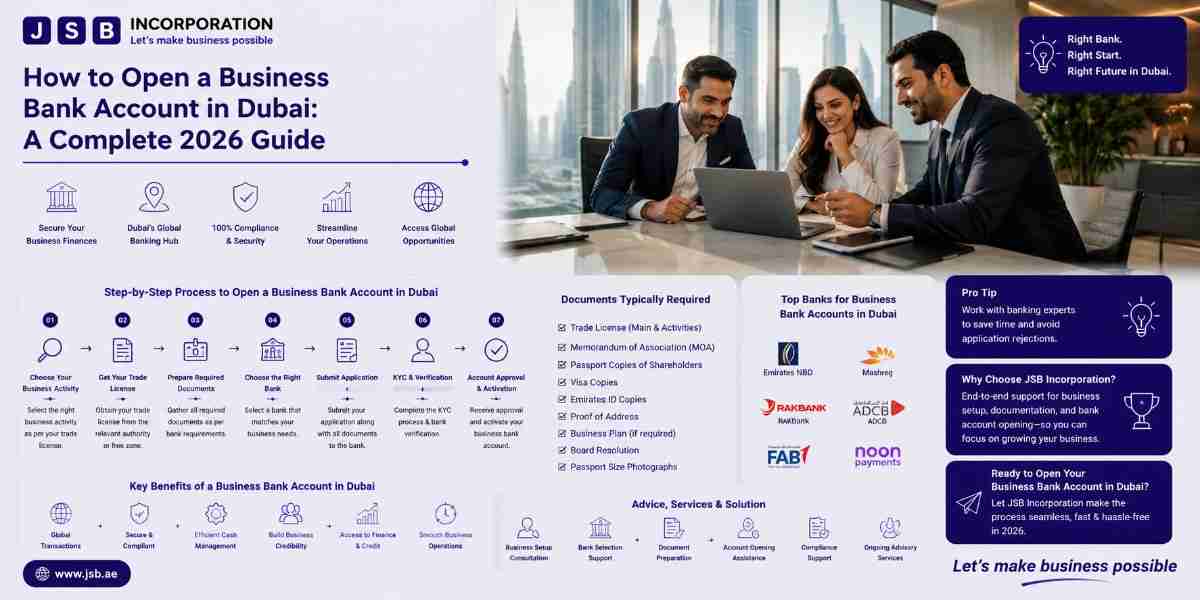
Quick Answer
Banks in Dubai require your trade license, Memorandum of Association (MOA), Articles of Association (AOA), and share certificate before they will consider your application.
You will also need to identify your Ultimate Beneficial Owner (UBO) and provide shareholder identification. These requirements come directly from the UAE Central Bank’s due diligence rules for legal persons, not from individual bank policy.
The Central Bank of the UAE’s Rulebook requires a licensed bank to verify the identity of the legal person, including its licences and incorporation documents, and to identify its Beneficial Owners before onboarding. This applies at the point of first contact, before you can transact.
Your document checklist typically breaks into three groups.
Company documents: trade license, MOA, AOA, share certificate, and certificate of incorporation.
Shareholder documents: passport copies, Emirates ID for residents, and proof of residential address for each shareholder and signatory.
Compliance documents: UBO declaration form, source-of-funds explanation, and a description of your expected business activity and transaction countries.
If your documents come back incomplete, it is usually because your company formation paperwork was not finalized correctly at the licensing stage.
Getting your trade license, MOA, and AOA fully in order before you approach a bank saves you a second round of paperwork later.
Digital banks generally offer faster, fully online onboarding with lower or zero minimum balance requirements, while traditional banks often ask for higher minimum balances but provide broader services such as trade finance and multi-currency facilities.
Neither option is government-mandated, since each bank sets its own thresholds and fee structure.
Account type | Typical minimum balance behavior | Onboarding speed | Best suited for |
|---|---|---|---|
Digital bank / neobank | Often lower or none, but confirm with the bank | Usually fast, largely digital | Startups and freelancers needing quick account access |
Traditional bank | Often higher; varies by bank and account tier | Can involve in-person steps | Businesses needing trade finance, larger transaction volumes, or multi-currency accounts |
All banks operating in the UAE are licensed and supervised by the Central Bank of the UAE, which sets the due diligence standard every institution must follow, even though the account fees and minimum balances themselves remain bank-specific.
Do not treat any specific AED balance figure you see online as fixed. Bank fee schedules change without notice, so always check the bank’s own published schedule at the time you apply.
Opening a business account follows a fairly consistent sequence: finalize your incorporation documents, prepare your company profile, choose a matching bank, submit your application, complete due diligence, then activate your account.
Each stage builds on the one before it, so missing a step early tends to cause delays later.
Whether the interview happens in person or online varies by institution and is not standardized by government rule, so confirm the current process with your chosen bank before you apply.
Company formation and banking often move in parallel rather than in strict sequence, which is why getting your licensing right early makes the banking step smoother.
Banks ask detailed questions about your source of funds and business activity because Central Bank rules require it, not because of individual bank preference.
Licensed institutions must understand your business purpose, ownership structure, and the legitimacy of your funds before they open your account.
The Central Bank of the UAE’s Rulebook requires banks to collect documents that verify and confirm the source of funds, the purpose of each transaction, and the commercial or economic reason behind it for legal persons and legal arrangements.
This is not a one-off checklist item. It underpins ongoing monitoring too.
Expect your bank to assess several things during onboarding and beyond.
Banks must also identify individuals who, individually or jointly, hold a controlling ownership interest of 25 percent or more in your company as part of Beneficial Owner identification under the same Rulebook.
If no one meets that threshold, the bank identifies your senior management instead.
Building a bank-ready company profile before you apply, with your business activity, expected turnover, and source of funds explained clearly, saves time at the interview stage.
Non-residents can open a business bank account in Dubai, but eligibility depends on the individual bank’s own policy, and additional documentation is typically required.
This usually includes home-country address proof, bank reference letters, and sometimes a higher minimum balance.
Because this is bank-discretionary rather than a fixed government rule, do not assume one universal requirement applies across every institution.
Check the specific bank’s published non-resident policy before you apply, since requirements shift between institutions and over time.
Holding UAE residency often reduces this friction, since a UAE residence visa gives you a local address and Emirates ID that many banks weigh favorably during onboarding.
Non-residents typically face these extra requests from banks.
Opening your account is not the end of the process.
Under the Central Bank of the UAE’s Rulebook, your customer profile must be reviewed and updated either annually or upon the expiry of your trade license or the ID of anyone authorized to transact on your behalf, whichever comes first.
That means periodic re-verification requests are standard, not a red flag.
This annual review requirement applies across every licensed bank operating in the UAE. Several events can trigger a re-review before the annual deadline arrives.
No, a residence visa is not a fixed requirement to open a business account, but it can simplify the process.
Non-residents can still apply, though banks typically request extra documentation like home-country address proof and bank reference letters, per each institution’s own policy.
2. Is Wio Bank or Mashreq NeoBiz suitable for a brand-new company?
Both are digital banking options aimed at faster onboarding for new companies, but suitability depends on your specific business activity, expected transaction volume, and banking needs.
3. What happens if my business bank balance falls below the bank’s minimum?
Consequences vary by bank and account tier and may include a monthly fee or account restrictions.
Since minimum balance rules are set by individual banks rather than UAE regulation, check your bank’s current published fee schedule rather than assuming a fixed figure.
4. Can I open a business account with only a flexi-desk address, no physical office?
Many banks accept a flexi-desk address alongside your valid trade license, though acceptance varies by bank and business activity.
5. Why was my business bank account application rejected?
Rejections commonly trace to incomplete incorporation documents, a mismatch between your licensed activity and your actual transactions, or an unclear source-of-funds explanation.
Addressing gaps in your company profile before reapplying generally improves your chances.
6. How often will my bank ask me to re-verify company documents after opening?
Under the Central Bank of the UAE’s Rulebook, your profile must be reviewed and updated at least annually, or sooner if your trade licence or an authorized signatory’s ID expires first. Expect periodic requests for updated documents rather than a single onboarding event.
7. Do digital banks support international transfers for UAE businesses?
Most digital banks operating in the UAE support international transfers, though specific corridors, fees, and processing times differ by institution.
8. What is the difference in documentation between a mainland and free zone company account?
Both mainland and free zone companies need a trade license, MOA and AOA, and UBO verification, but the certificate format can differ depending on which authority issued your incorporation documents.
Reviewed by Gaurav Keswani, Founder, JSB Incorporation
Gaurav Keswani is the Founder of JSB Incorporation, a Dubai-based business setup and immigration consultancy. He appeared on Talk 100.3 FM, answering live listener questions on UAE Golden Visa eligibility, citing GDRFA and ICP guidelines directly on air. JSB Incorporation handles documentation preparation and application coordination; all visa and license decisions rest with the relevant UAE government authorities—GDRFA, ICP, DET, and DLD.
Getting a Dubai business bank account approved starts with a complete company file and a clear source-of-funds story, and it does not end at approval since your bank will re-review your profile at least annually.
If you would rather not manage documentation, bank selection, and renewal deadlines on your own, JSB’s team can prepare your bank-ready profile, help match you to the right account type, and track your annual review so nothing lapses.
Also Read:
How to Open a Business Bank Account for a SaaS Startup in Dubai
UAE Business Bank Accounts for Startups & SMEs in 2026: Best Options by Use Case
Mainland vs Free Zone Business Bank Accounts in UAE 2026: What Really Makes Banking Easier for You

Office 2505, 25th Floor, Regal Tower, Business Bay, Dubai, UAE P.O Box 27614.
+971 4 824 4842
info@jsbincorporation.com