
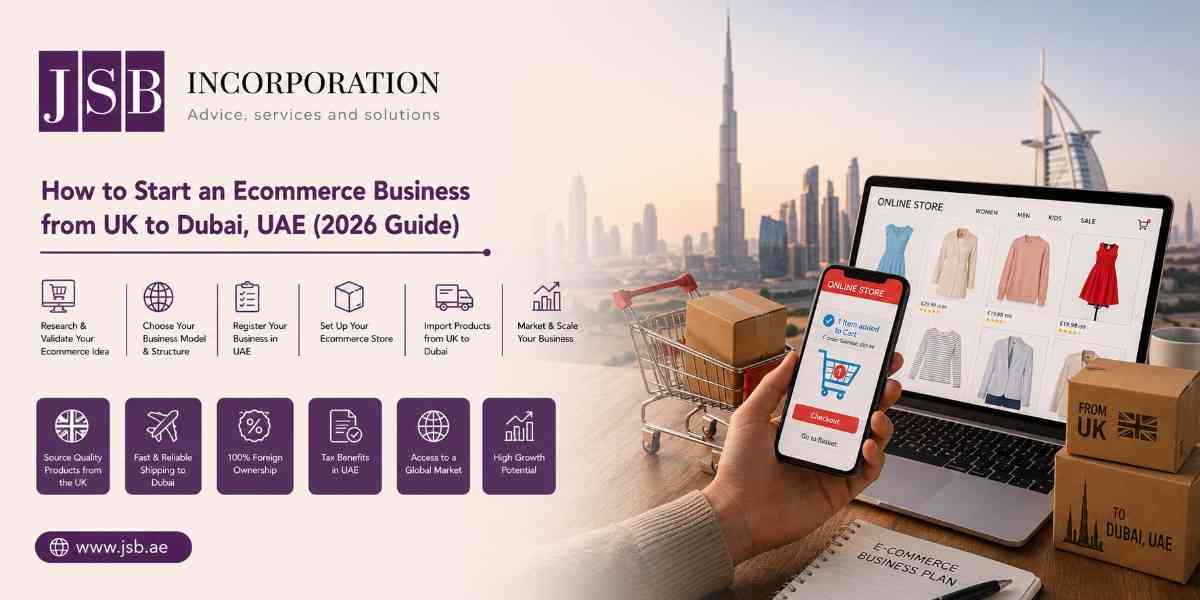
Key Highlights
The UAE e-commerce market is valued at USD 12.30 billion in 2026 and is forecast to reach USD 21.01 billion by 2031, growing at an 11.29% CAGR, according to Mordor Intelligence.
This market isn’t finding its feet. It’s already moving fast, and the legal framework for 100% foreign-owned e-commerce businesses is clearer than most people expect.
This guide covers everything: licenses, verified costs, UAE e-commerce law, a step-by-step setup process, tax obligations, and marketplace access.
Keep reading to learn more.
The tax contrast is what gets most people’s attention first, and it’s genuinely significant. The UK taxes personal income at 40% above the higher-rate threshold and 45% at the additional rate. The UAE has zero personal income tax. That one difference reshapes the entire financial picture for a profitable e-commerce seller tired of watching a large share of income disappear each year.
On the corporate side, the UAE introduced a 9% corporate tax on net profits above AED 375,000 (roughly £80,000) for financial years beginning on or after 1 June 2023. Profits below that threshold are taxed at 0%.
If your UAE-registered business earns below AED 3 million in revenue, you may also qualify for Small Business Relief, which allows you to be treated as having no taxable income for that period. This relief is available for tax periods ending on or before 31 December 2026, so it’s worth factoring in if you’re in the early stages of scaling. Verify current eligibility at the official UAE government portal.
Free zone businesses may also qualify for Qualifying Free Zone Person (QFZP) status, which allows a 0% corporate tax rate on qualifying income. But this isn’t automatic just because you hold a free zone license. You need genuine economic substance in the UAE, meaning active business management from within the zone, real operations, and proper documentation.
It’s also important to know that income derived from selling to UAE mainland customers may not qualify as income eligible for the 0% QFZP rate. Running everything from Birmingham while holding a Dubai license won’t qualify you for that benefit.
Post-Brexit, the trade access argument carries real weight too. UAE free zones allow GCC re-export at 0% customs duty on most product categories, a route that no longer exists for UK sellers into the EU.
According to a Dubai Chamber of Commerce analysis based on Euromonitor data, UAE e-commerce was projected to reach USD 9.2 billion by 2026, with e-commerce accounting for 12.6% of total retail sales in the country by the same year.
The UK-UAE Double Taxation Agreement, signed in 2016 and in force from 2017, provides a framework for cross-border income. Since the UAE only introduced its corporate tax regime in 2023, how the DTA applies to your specific situation needs professional advice, not general assumptions.
Your first real decision is where to register, and it shapes your tax eligibility, retail access, and marketplace options from day one.
A free zone license fits you best if you’re running an online-only store, selling cross-border or into the GCC, or planning to list on Amazon.ae or Noon. It’s also your route to QFZP tax eligibility.
A mainland license issued by the Department of Economy and Tourism (DET) in Dubai is what you need if you want to operate physical retail in the UAE or build direct relationships with local distributors.
Since Federal Decree-Law No. 26 of 2020, which came into effect in early 2021, 100% foreign ownership is available in both structures for most business activities.
Federal Decree-Law No. 20 of 2025, effective October 2025, further clarified the regulatory framework between free zone and mainland companies, introducing re-domiciliation rights and clearer rules for free zone companies seeking to operate in the mainland.
Free zone companies looking to expand into mainland Dubai now do so through the DET under Dubai Executive Council Decision No. 11/2025, which requires DET approval and a physical office. Verify the current rules at the official UAE government portal before you proceed.
Here’s how the two options compare:
Factor | Free Zone | Mainland (DET) |
Foreign Ownership | 100% | 100% |
Direct UAE Physical Retail | No | Yes |
Amazon.ae / Noon Access | Yes (UAE license required) | Yes |
QFZP Tax Eligibility | Yes (substance required) | No |
Best For | Online-only, GCC export | UAE physical presence |
Your realistic total startup investment runs from AED 20,000 to AED 50,000, approximately £4,200 to £10,500. The table below gives you a verified cost reference across the main free zone options:
Free Zone | License Fee (AED) | Registration | Flexi Desk/year (AED) | Visa (AED) |
RAKEZ | From 6,000 | Included | 10,000-15,000 | 3,500-5,000 |
Meydan | From 12,500 (package) | Included | Included (some packages) | 3,500-5,000 |
IFZA, 1-yr Zero Visa | 11,900 incl. VAT | Included | Free FlexiDesk (2026 promo) | 3,750 (2-yr govt fee, if applying separately) |
IFZA, 1-yr 1-Visa | 14,900 incl. VAT | Included | Free FlexiDesk (2026 promo) | 1 visa free for life of license (promo) |
DMCC | 15,000-20,000 | 6,000-8,000 | 15,000-25,000 | 3,500-5,500 |
Dubai CommerCity | Premium/ecommerce-specific | Variable | Variable | 3,500-5,500 |
IFZA pricing is sourced from the official IFZA 2026 Partner Price List, inclusive of VAT. There are additional cost items to budget for:
One important detail on the IFZA 2026 free visa promotion: it covers the standard Dubai Naturalization and Residency Department (DNRD) visa issuance and renewal charge of AED 3,750.
It doesn’t cover the Establishment Card, medical exams, Emirates ID registration costs, or visa status change fees. Those are separate costs to budget for. IFZA reserves the right to amend pricing without prior notice, so always confirm current fees at the official IFZA portal before committing.
Looking for UAE free zone business setup support? JSB’s advisors match your e-commerce model to the right jurisdiction and handle the entire process.
Book a free call with JSB today.
Disclaimer: All license fees and costs shown above are reference figures based on official free zone pricing at the time of writing. Fees are subject to change without notice. Verify current costs at each free zone’s official portal and with a licensed UAE business setup advisor before making financial decisions.
You don’t need to be physically present in the UAE to fall within its e-commerce regulations, and that’s something that catches a lot of UK sellers off guard.
The primary legislation is Federal Decree-Law No. 14 of 2023 on Trading by Modern Technological Means, which came into force in September 2023. It covers all commercial activity conducted through websites, mobile apps, social media platforms, and digital marketplaces.
The law applies to any business selling goods or services into the UAE from outside the country, so if you’re already shipping to UAE customers from the UK, you’re already within its scope.
The implementing regulations under this law were still evolving at the time of enactment, which means your compliance obligations may be broader than what’s visible at first read. Work with a licensed UAE advisor to get a current picture.
All ecommerce licenses in the UAE require a No-Objection Certificate (NOC) from the Telecommunications and Digital Government Regulatory Authority (TDRA), the federal body responsible for regulating the UAE’s ecommerce framework.
The NOC is free of charge and applies to both mainland and free zone operations. It needs to be part of your application process from the beginning, not addressed after launch. If you sell electronics, UAE conformity requirements apply, and your UK CE marking won’t be automatically accepted in the UAE market.
The UAE’s Personal Data Protection Law, Federal Decree-Law No. 45 of 2021, became effective on 1 January 2026 with a one-year transition period running until full enforcement on 1 January 2027.
It applies to any organization worldwide that processes personal data of UAE residents, so if you’re collecting checkout or behavioral data from UAE customers through Shopify or Amazon, PDPL compliance applies to you.
On VAT, the standard rate is 5% on domestic UAE sales and exports are zero-rated. Federal Decree-Laws No. 16 and 17 of 2025 introduced updated VAT procedures effective 1 January 2026, covering new five-year refund time limits, updated reverse charge rules, the Federal Tax Authority’s (FTA) authority to issue binding directions, and strengthened anti-evasion measures. Verify your registration threshold and current obligations at the FTA portal.
The process is more manageable than it looks. Here’s the full sequence in order:
Your typical timeline from document submission to active license is 5 to 10 business days when working with a registered agent. Document readiness and free zone processing times can affect this.
Book your free consultation here.
Let’s answer the question that comes up constantly in UK entrepreneur forums: does registering a UAE company remove your UK tax liability? No, it doesn’t. Not on its own.
The UAE’s 0% personal income tax and 9% corporate tax rates only apply when you’ve established genuine economic substance in the UAE. That means you hold a UAE investor visa and Emirates ID, you’re actively managing your business from within the UAE, and you have a meaningful physical presence in the country.
Without those elements, HMRC has grounds to treat your UAE income as UK-sourced. Review HMRC’s guidance on overseas income and tax residency at GOV.UK before making any structural changes to your setup.
QFZP status, which opens the 0% rate on qualifying free zone income, is a legitimate and valuable structure when properly set up. But it’s not automatic, and you shouldn’t plan your finances around it without first verifying eligibility. Remember that income derived from selling to UAE mainland customers may not qualify under QFZP rules.
The UK-UAE Double Taxation Agreement, signed in 2016 and in force from 2017, gives you a useful framework but doesn’t resolve all UK exposure on its own, particularly now that the UAE has had its own corporate tax regime in place since 2023.
How the two systems interact for your specific situation needs tailored professional advice from both a qualified UAE tax advisor and a UK-registered tax counsel.
The January 2026 VAT amendments under Federal Decree-Laws No. 16 and 17 of 2025 also introduced updated reverse charge procedures, five-year refund time limits, and stronger anti-evasion rules that are relevant if you have domestic UAE sales. Verify your obligations at the FTA portal.
Disclaimer: This article is for informational purposes only and doesn’t constitute tax or legal advice. UK sellers must consult a qualified UAE tax advisor and UK-registered tax counsel before restructuring any business or personal tax arrangement.
Q1: Can I set up a UAE e-commerce company from the UK without relocating?
Yes, remote registration is possible and the application process can be completed without being physically present in the UAE.
But genuine physical presence and active business management from within the country are required to build the tax substance that HMRC would recognize. Setting up remotely while running your operations entirely from the UK won’t give you the tax benefits you’re looking for.
Q2: What’s the cheapest ecommerce license in Dubai in 2026?
RAKEZ starts from AED 6,000 for the license fee. IFZA’s zero-visa 1-year license is AED 11,900 inclusive of VAT, with a free FlexiDesk included under the current 2026 promotion.
Your realistic total startup cost, including the Establishment Card (AED 2,000), visa, Emirates ID, and setup fees, runs from AED 20,000 to AED 50,000, approximately £4,200 to £10,500. Always verify current fees at each free zone’s official portal, as pricing can change.
Q3: Do I need a UAE trade license to sell on Amazon.ae?
Yes. A UK-registered company can’t register as a seller on Amazon.ae or Noon. A valid UAE trade license is mandatory for marketplace onboarding on either platform.
Q4: Is there VAT on e-commerce sales in the UAE?
Yes. 5% VAT applies on domestic UAE sales. Exports are zero-rated. Updated VAT procedures came into effect on 1 January 2026 under Federal Decree-Laws No. 16 and 17 of 2025. Verify your registration threshold at the FTA portal.
Q5: What is a QFZP and do I qualify?
A Qualifying Free Zone Person pays 0% corporate tax on qualifying income. To qualify, you need genuine economic substance in a UAE free zone, active operations managed from within the zone, and proper documentation.
Note that income from UAE mainland customers may not qualify under QFZP rules. Verify current eligibility criteria at the UAE Ministry of Economy portal.
Q6: How long does UAE ecommerce company setup take?
Typically 5 to 10 business days when working with a registered agent, provided your documents are ready. Processing times vary by free zone and the complexity of your chosen license activity.
The UAE e-commerce market is at USD 12.30 billion in 2026 and it’s growing steadily. The legal framework fully supports 100% foreign-owned businesses, GCC re-export access opens up markets that post-Brexit Europe has closed off, and the setup timeline is measured in days, not months.
But the tax efficiency, QFZP benefits, and Amazon.ae access all come down to getting the structure right from day one. The license alone doesn’t do it.
You need genuine UAE substance, the right free zone for your business model, a UAE corporate bank account, and a TDRA NOC locked in before you start selling. Those are the pieces that make the whole thing work.
JSB handles all of it. From jurisdiction selection and trade license to corporate bank account opening, visa processing, and marketplace registration support, you get end-to-end guidance without navigating multiple portals on your own.
Book your free consultation call today with the experts of JSB Incorporation to learn more.
Also Read:
18 Common Business Setup Mistakes in Dubai and How to Avoid Them
UAE Business Setup and Golden Visa in 2026: A Comprehensive Analysis
How Long Does Business Setup Take in UAE in 2026? (Per Jurisdiction Breakdown)
The Ultimate Comparison: Business Setup in IFZA Free Zone vs. Mainland Dubai

Office 2505, 25th Floor, Regal Tower, Business Bay, Dubai, UAE P.O Box 27614.
+971 4 824 4842
info@jsbincorporation.com
