
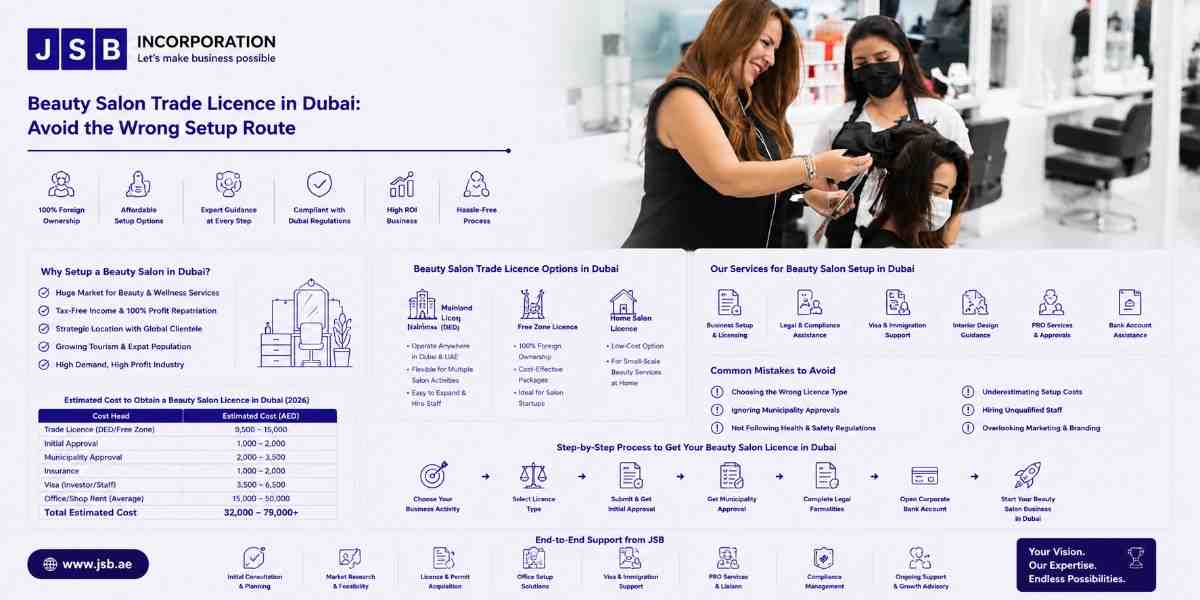
Key highlights
As of July 2026, a beauty salon trade licence in Dubai starts with the authority route, not the paperwork, because Dubai Economy and Tourism (DET) issues Dubai mainland trade licences while Free zone authorities issue their own licences.
If you choose the wrong route first, you can spend time and money on a structure that does not match how your salon will operate, serve customers, or expand later.
This guide shows you what the licence path actually involves, what to check before you appoint a setup provider, and how JSB supports the process.
Your first decision is the route. The paperwork only makes sense after the route matches your salon model, premises plan, and customer access.
A beauty salon trade licence in Dubai usually begins with three linked decisions: the business activity, the licensing authority, and the operating setup.
DET handles mainland trade licences in Dubai, while Free zone authorities run their own licensing frameworks, so the route needs to fit how your salon will actually work.
For a salon business, the licence conversation starts with the activity you want to carry out and where the business will operate. Dubai mainland company formation sits under DET for local mainland licensing, while the Ministry of Economy (MOEC) remains the federal authority behind the wider commercial companies’ framework.
The ownership position is clearer than it used to be. Under Federal Decree-Law No. 26 of 2020, mainland company ownership permits 100% foreign ownership for most activities, and DET and MOEC state that a local sponsor is no longer mandatory for most activities.
That doesn’t mean every route suits every salon. A customer-facing salon needs a route that matches the real operating model, not just a package that looks simple at the start.
Many buyers start with price, broad package claims, or a generic licence label. The bigger decision is whether the route fits your physical setup, your intended customer base, and the authority that will regulate the licence from day one.
That is why route fit matters before submission. If the setup logic is weak at the start, the later documentation and authority steps become slower, more expensive, and harder to correct.
Authority control still sits with the relevant UAE body, not with the consultant preparing the file. In Dubai mainland cases, that means the licence path remains anchored to DET from the start.
The right provider checks route fit before filing, explains the authority path clearly, and stays involved after the initial licence stage. That approach helps you avoid paying for a setup path that looks convenient early on but creates friction later.
A strong provider should explain whether your salon model fits a mainland path or whether another authority route is even worth considering. That judgment should come from how your business will operate, not from a one-size-fits-all package.
This is where the wider business setup in Dubai decision matters, because your structure affects the licence path, the activity framing, and the next steps after incorporation.
You also need a provider who can align the chosen activity with the right authority pathway from the start. That means reviewing the route first and preparing the documents around that route instead of forcing every case into the same checklist.
This is also where mainland vs. free zone Dubai becomes a practical decision rather than a marketing phrase. The answer depends on how your salon will function in the real market and which authority framework fits that setup.
The licence stage is only one part of the process. You may also need support with company amendments, renewals, bank account documentation guidance, and related visa coordination after the trade licence is issued.
That wider support matters because setup decisions don’t end at incorporation. If you are comparing service depth, the trade license in Dubai discussion should include what happens after approval, not only how the first application is submitted.
JSB starts with the route decision first, then coordinates the setup steps that sit inside its confirmed company formation and trade licence support scope. That helps you assess the correct path before documents are submitted to the relevant authority.
For a salon buyer, that means the setup logic is reviewed before the file moves forward. The activity, authority path, and documentation are aligned before submission so you are not paying to correct a weak route choice later.
JSB also stays inside the correct consultant boundary. JSB prepares and coordinates the application, while the final licence decision remains with the relevant UAE authority.
This business setup review reflects the detail-focused support many company formation buyers want before they commit to a provider.
“We were helped by the gentleman named Gaurav who was kind enough to drive down to the place where we lived and explained to us the process in detail. Gaurav is confident about his work and has extensive knowledge about the DED process. We consulted a few other service providers but Gaurav knew something that the other providers in the market did not. Thank you for hand holding us in the initial set up including bank account opening. Will denitely come back in future!”
1. Do you need a mainland company for a beauty salon in Dubai?
A beauty salon often needs a route that matches a customer-facing operating model, which is why the mainland path becomes central in many Dubai setup discussions.
DET issues Dubai mainland trade licences, so the right answer depends on how your salon will trade, where it will operate, and which authority framework fits that reality.
2. Can a beauty salon in Dubai operate from a Free zone?
A Free zone route should not be assumed just because it sounds simpler at the start. Free zone authorities issue their own licences, and the route still needs to match how your salon will operate in practice before any documents are submitted.
3. Which approvals usually matter before a salon opens in Dubai?
The first approval question is the authority route itself. DET handles Dubai mainland trade licences, while Free zone authorities govern their own setups, so the operating model, business activity, and documentation path all need to stay aligned with that authority from the beginning.
4. How long does a beauty salon trade licence take in Dubai?
There’s no single timeline that fits every salon setup. Timing depends on the authority route, the business activity, the readiness of the documents, and the pace of authority processing, so no provider should present licence issuance as guaranteed on a fixed date.
The next smart step is to validate the route before you commit to the application path.
DET remains the authority for Dubai mainland trade licences, while MOEC and the Official UAE Government Portal remain key references for company formation structure and licence verification.
Book a free business setup consultation with JSB today.
Also Read:
18 Common Business Setup Mistakes in Dubai and How to Avoid Them
UAE Business Setup and Golden Visa in 2026: A Comprehensive Analysis
How Long Does Business Setup Take in UAE in 2026? (Per Jurisdiction) Breakdown)
The Ultimate Comparison: Business Setup in IFZA Free Zone vs. Mainland Dubai
Reviewed by: Gaurav Keswani, Founder JSB Incorporation
Gaurav Keswani is the Founder of JSB Incorporation, a Dubai-based business setup and immigration consultancy. He appeared on Talk 100.3 FM answering live listener questions on UAE Golden Visa eligibility, citing GDRFA and ICP guidelines directly on air.

Office 2505, 25th Floor, Regal Tower, Business Bay, Dubai, UAE P.O Box 27614.
+971 4 824 4842
info@jsbincorporation.com
