
 Gaurav Keswani
Key Highlights
You have already made the big decision. Your software company is going to Dubai. Now you are stuck on a smaller question that somehow feels bigger: is DMCC worth paying a premium for, or is IFZA the smart default, and where does Dubai Internet City actually fit?
You have probably read that the UAE has dozens of free zones. The Ministry of Economy and Tourism free zones directory lists options across all seven emirates, and Dubai alone hosts a long roster on the Invest in Dubai government portal. That is a lot of noise when you just want to write code and ship product.
So this guide narrows to the three names Chinese software founders keep circling back to and nothing else.
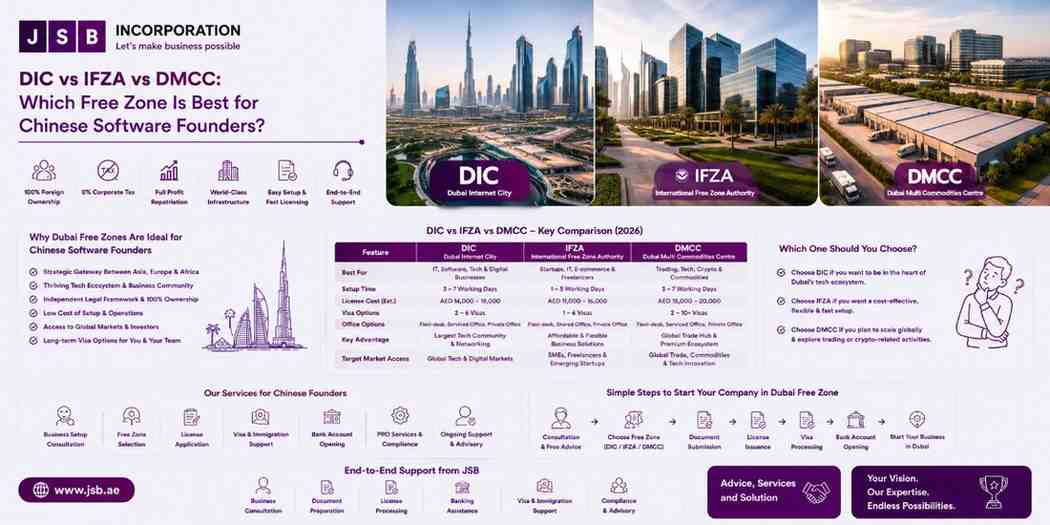
Here is the short version before we go deep. Read this, then read the section that matches your situation.
Factor | Dubai Internet City (DIC) | IFZA | DMCC |
Setup cost range (Year 1) | License from AED 15,000; full package not published, workspace typically required | 1-year license from AED 11,900 (zero visa) to AED 16,900 (2 visa) | Start-up packages from around AED 43,780 to AED 51,129 |
Office requirement | Commercial space and co-working options; physical presence emphasized | FlexiDesk included free on zero to three visa packages, no mandatory office | A flexi desk or co-working included in start-up packages |
Visa flexibility | Standard free zone visas | 1, 2, 3, or above allocations; one residence visa free for the life of the license under the current promotion | Visa quota tied to package and workspace |
Best-fit founder | Funded or brand-conscious tech firms wanting proximity to major tenants | Solo founders, small dev teams, IT consultancy models | Growth-stage firms prioritizing banking ease and credibility |
Banking reputation | Strong tech-cluster standing | Widely accepted, practical | Large member base and established bank relationships |
Dubai Internet City is a dedicated technology hub. It presents itself as the region’s leading tech hub on its official portal, and it sits under TECOM Group, the operator behind Dubai’s cluster of industry-specific business districts.
The whole point of DIC is physical proximity. You are buying a seat inside a district built around information and communications technology companies, with commercial space, co-working areas through D/Quarters, and the in5 platform for startups.
If your reason for choosing a zone is simply that you want to be close to other tech companies, this is the zone that answers it.
That focus comes with a practical cost consideration. The published license fee on the Invest in Dubai government page is AED 15,000 for standard licenses, with a freelancer option at AED 7,500. What the official pages do not publish is a full, itemized Year 1 setup package the way IFZA and DMCC do.
The DIC company setup emphasizes commercial space and workspace offerings, which usually pushes the real all-in cost above the headline license figure. We are flagging that gap on purpose rather than filling it with an estimate.
Who fits here? Funded or brand-conscious software companies that value being inside the cluster. A first-time solo founder watching every dirham is usually not the target.
For most Chinese software founders arriving without a big office plan, IFZA is the practical default. It is based in Dubai Silicon Oasis, part of Dubai’s technology corridor, and it is built around flexibility.
Two things make IFZA company formation the low-friction choice. First, there is no mandatory private office. The current IFZA promotion includes a free FlexiDesk on new licenses with zero, one, two, and three visa allocations.
Second, you can pick your commitment length: one, two, three, or five year license terms, with larger multi-year discounts baked in.
The pricing is where IFZA earns its reputation for being easier to get up and running. Standard prices inclusive of VAT for a one-year license look like this:
IFZA 1-year license (standard, incl. VAT) | Price |
Zero visa license | AED 11,900 |
1 visa license | AED 14,900 |
2 visa licenses | AED 16,900 |
3 visa licenses | AED 18,900 |
Under the current promotion, the one residence visa included with a visa package is free for the life of the license, subject to continual renewal of the business package. The government-related fees still apply on top.
IFZA’s fee schedule lists an initial Establishment Card at AED 2,000 and a two-year UAE Residence Visa fee at AED 3,750, among other line items.
Who fits here? Solo Chinese founders, small development teams, and IT consultancy models that do not need a dedicated office. If cost control, speed, and flexibility are your priorities, IFZA is usually where you land.
DMCC is the name that makes founders pause, because it costs meaningfully more, and the question they keep asking is simple: is the premium worth it?
Start with what you actually pay. DMCC’s own business setup packages show start-up options such as the Jump Start Package, with advertised prices in the range of roughly AED 43,780 to AED 51,129 depending on the workspace choice, one of which includes a company license, a flexi-desk or co-working space, and one residence visa.
Its Schedule of Charges lists standard license pricing at AED 20,285 annually, new company registration at AED 9,000, an application fee of AED 1,015, and an establishment card at AED 1,825, with new outside-country employment visas around AED 2,972.50.
There is also a sector-specific angle worth knowing. DMCC runs dedicated ecosystem packages, including a DMCC AI Centre package advertised at AED 31,000, aimed at AI and technology businesses. That can narrow the cost gap for the right software company.
Now the honest part about total cost. QFZP status under UAE corporate tax requires audited financial statements, and DMCC’s Schedule of Charges reflects that world with items like approved auditor registration fees and operational fitness certificates.
Those substance and compliance line items are real, and they add up over the year. So the DMCC premium is not just the license number; it is the fuller compliance footprint.
Who fits here? Growth-stage companies where banking ease and international credibility outweigh the cost premium, which brings us to the reason DMCC business setup keeps coming up for Chinese-owned firms specifically.
Here is the closest apples-to-apples view we can build using only official and on-file sources. Where a figure is not published by an official source, we say so rather than guess.
Cost item | DMCC | IFZA | DIC |
License fee | AED 20,285 standard annual license | From AED 11,900 (1-year, zero visa) | AED 15,000 standard license |
Registration fee | AED 9,000 new company registration, plus AED 1,015 application | Included in package price | Not published as a separate figure on official pages |
Visa cost per visa | Around AED 2,972.50 for a new employment visa (outside country) | AED 3,750 residence visa; one visa free for life under current promotion | Standard free zone visa; not itemized publicly |
Office / FlexiDesk | A flexi desk or co-working included in start-up packages | Free FlexiDesk on zero to three visa packages | Commercial space and co-working offered; often required |
Estimated Year 1 total | Start-up packages from about AED 43,780 to AED 51,129 | From about AED 11,900 plus government fees such as the AED 2,000 establishment card | Not published as a full package by an official source |
The Invest in Dubai portal is clear that free zone costs depend on the zone, the license type, the business activity, and the office space and that all listed costs are indicative and must be confirmed with the zone before you start. We are treating that as the authoritative baseline.
If you are a Chinese national or a Chinese company setting up in Dubai, one cost layer applies no matter which of these three zones you pick: your Chinese-issued corporate documents need to be recognized in the UAE.
That means notarization at home and attestation for use here. A Power of Attorney or your company’s Memorandum and Articles typically go through notarization, authentication by the issuing country’s authorities, legalization at the UAE mission, and finally attestation by the UAE Ministry of Foreign Affairs.
The Ministry’s schedule sets attestation at AED 150 for a personal document and AED 2,000 for a commercial document. This is a shared cost across all three zones, so it is not a reason to prefer one over another.
Where the zones genuinely differ is banking, and this is where the DMCC debate gets a concrete answer. When you open a UAE business bank account, the bank must run customer due diligence under the Central Bank of the UAE Rulebook.
Article 8 of Cabinet Decision No. 10 of 2019 requires the bank to verify the customer’s identity and understand the nature of the client’s business along with the client’s ownership and control structure.
For a Chinese-owned entity, that ownership and control layer matters. Article 9 requires the bank to identify the natural person who owns or controls 25% or more of a legal person, using reliable, independent documents.
And the AML-CFT Guidelines direct banks to apply Enhanced Due Diligence where a customer has a complex structure or an unclear economic objective. A cross-border ownership chain from China can trigger exactly that deeper review.
This is the practical, grounded reason DMCC’s stronger and more established bank relationships can reduce account-opening friction for Chinese-owned companies. It does not change the legal requirements, which apply everywhere. It can change how smoothly you get through them.
Quick compliance checkpoint, not a selling point. All three zones sit inside the same UAE corporate tax framework.
The headline rates, per the official corporate tax page, are 0% on taxable income up to AED 375,000 and 9% above it. A company in any of these zones can access a 0% rate on qualifying income as a Qualifying Free Zone Person, but only if it meets every QFZP condition.
Those conditions, summarized from the Federal Tax Authority framework reflected on the Invest in Dubai corporate tax guidance, include maintaining adequate substance in the free zone, deriving qualifying income, not electing into standard corporate tax, complying with transfer pricing rules, preparing audited financial statements, and keeping non-qualifying revenue under the de minimis limit of the lower of 5% of total revenue or AED 5 million in a tax period.
Miss the de minimis limit and the entity can lose QFZP status for that period and the following four.
Because QFZP conditions are subject to periodic amendment, verify your specific position against the current guidance from the Federal Tax Authority at the time you file.
Strip away everything else and it comes down to three clear paths.
It depends on your stage. If you are early and cost-sensitive, IFZA usually wins on price, with one-year licenses starting from AED 11,900.
If you are growth-stage and banking access is a priority, DMCC’s established bank relationships and credibility can justify packages that start around AED 43,780, per its official packages.
2. Do I need a physical office in Dubai Internet City?
DIC emphasizes commercial space and co-working options on its official portal, and physical presence is part of its identity as a cluster. The exact workspace terms should be confirmed directly with DIC, since its full package is not itemized on public government pages.
3. Which free zone is easiest to close down if the business does not work out?
Cancellation involves fees in every zone. IFZA’s fee schedule lists a business license cancellation fee of AED 2,000, for example.
DMCC’s Schedule of Charges publishes its own cancellation and related items. Confirm current exit costs with the specific zone before you assume one is simpler.
4. Can a Chinese national own 100% of a software company in any of these three zones?
Yes. UAE free zones allow full foreign ownership, as stated on the official guide to starting a business in a free zone. That applies to a Chinese individual or a Chinese corporate shareholder.
5. Is DMCC really better for opening a business bank account than IFZA?
The banking rules are identical everywhere, since all UAE banks follow the Central Bank of the UAE Rulebook on customer due diligence. What can differ is friction.
DMCC’s larger, more established bank relationships can help a Chinese-owned entity move through due diligence more smoothly, especially where a cross-border ownership structure invites Enhanced Due Diligence.
6. Do I still pay 0% corporate tax in these free zones in 2026?
You can, on qualifying income, if you meet the Qualifying Free Zone Person conditions. The official source confirms 0% up to AED 375,000 and 9% above it, and QFZP status delivers 0% on qualifying income only. Non-qualifying income above the threshold is taxed at 9%.
7. Can I register my company remotely from China, or must I visit Dubai in person?
Free zone applications are largely handled online through the respective authority, and the official free zone guidance notes that licenses are typically issued within 14 working days after review. In practice, banking and biometrics for your residence visa usually requires a visit at some stage, so plan for at least one trip.
Picking between DIC, IFZA, and DMCC is not really about which zone is best. It is about which one is best for your stage, your budget, and your banking needs as a Chinese software founder. Get that match right and the rest of the setup gets easier.
If you want a setup partner that works across DMCC, IFZA, and many other UAE jurisdictions, JSB Incorporation supports the full journey: company formation, trade licenses, UAE residence visas, bank account opening, and tax and VAT compliance.
The value is straightforward. Transparent guidance, end-to-end support, and a process built to get you operating in weeks, not months.
Book a free consultation call today.
Disclaimer: All pricing, fees, tax rates, and regulatory details in this article are indicative and were compiled from official and on-file sources at the time of writing. Costs and rules change without notice. Always confirm current figures and requirements with the relevant free zone authority, the Federal Tax Authority, the Central Bank of the UAE, and the official portal before making any decision.
Also Read:
18 Common Business Setup Mistakes in Dubai and How to Avoid Them
UAE Business Setup and Golden Visa in 2026: A Comprehensive Analysis
How Long Does Business Setup Take in UAE in 2026? (Per Jurisdiction) Breakdown)
The Ultimate Comparison: Business Setup in IFZA Free Zone vs. Mainland Dubai

Office 2505, 25th Floor, Regal Tower, Business Bay, Dubai, UAE P.O Box 27614.
+971 4 824 4842
info@jsbincorporation.com