
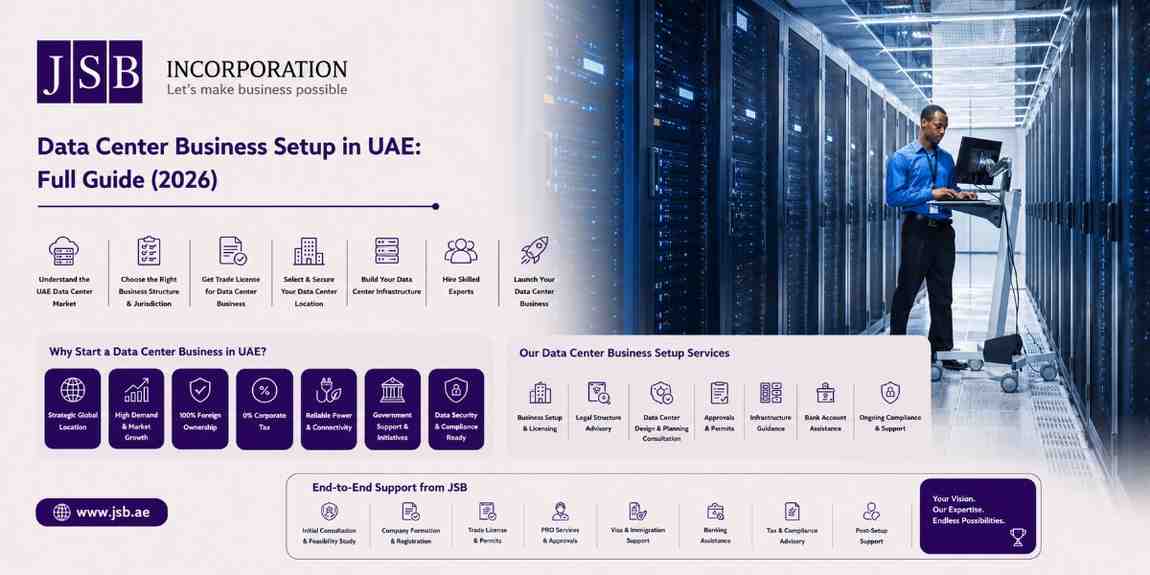
Key Highlights
The UAE data center market is valued at USD 1.74 billion in 2026 and is on track to reach USD 3.86 billion by 2031. Hyperscalers are pouring capital in. AI infrastructure demand is rising faster than available capacity. And the UAE government’s digital economy strategy is actively pulling more operators into the market.
If you’re a foreign IT entrepreneur trying to figure out how to set up a data center company here, you’ve probably already hit the wall. Which free zone? Do you need a TDRA license? How do you structure it for mainland clients? And what does this actually cost, with real numbers, not estimates?
This guide walks you through every decision in the right order, with figures and official sources, so you can move forward without second-guessing yourself.
Three things make the UAE stand out as a location for data center investment. The government has built deliberate policy around becoming a regional hub for cloud, AI, and digital infrastructure.
You can own 100% of your company, both in the UAE’s more than 40 free zones and on the mainland under the 2021 foreign ownership reforms. And the geography is a real commercial advantage. The UAE sits between Europe, Asia, and Africa, giving colocation and cloud operators a low-latency position that’s hard to match elsewhere.
The TDRA (Telecommunications and Digital Government Regulatory Authority), which was restructured under Federal Decree-Law No. 23 of 2020, actively supports cloud and data center expansion and has publicly welcomed major infrastructure investments in the country.
Zero percent corporate tax applies to qualifying free zone income. On the mainland, the rate is 9% on profits above AED 375,000.
Your business model determines your license activity, your ideal free zone, and which regulator has authority over your operations. Get this right before you touch anything else.
Once you’ve nailed this down, you’ll know whether the TDRA, DED, or your free zone authority takes the lead on your licensing. That clarity makes every step faster.
Factor | Free Zone | Mainland |
Foreign Ownership | 100% | 100% (post-2021 reforms) |
Corporate Tax | 0% on qualifying income | 9% above AED 375,000 |
Primary Client Base | International, B2B, cloud clients | UAE government entities, banks, regulated sectors |
Regulatory Speed | Single free zone authority window | Multiple approvals: DED, Municipality, Civil Defense |
Physical Infrastructure | Pre-built tech parks (DSO, IFZA, DMCC) | Custom-built site with full municipal approvals |
Mainland Access | Branch permitted under CCL Amendment (Oct 2025) | Direct operations |
Here’s the development that changes the equation for most foreign operators. Under Federal Decree-Law No. 20 of 2025, effective 14 October 2025, your free zone company can now establish an onshore branch without re-incorporating.
Free zone companies also now carry UAE nationality under amended Article 9 of the Commercial Companies Law. That means you get free zone tax efficiency and setup speed, plus the ability to serve UAE government and regulated sector clients through a licensed branch.
For most foreign IT infrastructure entrepreneurs, a free zone is the right starting point.
Not every free zone supports IT infrastructure and data center activities the same way. Here are the strongest options:
There’s no single “data center license” in the UAE. It’s activity-based, jurisdiction-specific, and often involves more than one authority.
You’ll register under terms like IT Infrastructure Services, Information Technology, Managed IT Services, Cloud Computing, or Data Storage Services. The exact activity name varies by free zone, so confirm it with your chosen authority before applying.
If you’re running colocation or telecom-adjacent services, TDRA oversight may apply. The TDRA is the federal regulator for telecommunications services under Federal Decree-Law No. 23 of 2020.
Note that TDRA telecommunications licenses carry ownership conditions. Unless otherwise approved by the TDRA Board, the percentage of foreign shareholders in the relevant entity shall not exceed 49%, while one or more UAE national partners must own the remaining 51%.
The applicable license type and eligibility criteria depend on the specific services you offer.
Your free zone trade license is typically issued within 14 working days of application.
Federal Decree-Law No. 45 of 2021 is the UAE’s first comprehensive federal privacy law, effective 2 January 2022. It covers data collection, processing, storage, breach notification, data subject rights, and cross-border transfers.
It applies to you if you’re processing the personal data of UAE residents, regardless of where your company is based. The UAE Data Office, established under Federal Decree-Law No. 44 of 2021, is designated as the federal data regulator for PDPL implementation and enforcement.
Federal Decree-Law No. 34 of 2021 covers your data security obligations and unauthorized access prevention. On top of that, Critical Information Infrastructure rules add data localization mandates for sovereign data categories, including healthcare, finance, and government data.
Your data center services are subject to 5% UAE VAT. Under the reverse charge mechanism, you don’t need to issue a self-invoice, but you do need to retain supporting documents per the Executive Regulation.
The FTA may deny your input tax deductions if a supply is connected to a tax evasion arrangement, so supplier due diligence matters.
2. CCL Amendment: Federal Decree-Law No. 20 of 2025
Your free zone company can now establish an onshore branch without re-incorporating. Drag-along and tag-along rights are now statutorily recognized under UAE law, which matters if you’re structuring a joint venture data center.
3. DIFC and ADGM
If you’re operating inside either financial free zone, they maintain their own GDPR-aligned data protection regimes that apply alongside or in place of the federal PDPL.
Disclaimer: Compliance requirements and regulatory obligations change. Always verify current requirements directly with the TDRA, UAE Data Office, FTA, and your chosen free zone authority. Nothing in this article is legal or tax advice.
License Package | 1-Year | 2-Year (15% off) | 3-Year (20% off) | 5-Year (30% off) |
Zero Visa | AED 11,900 | AED 20,200 | AED 28,600 | AED 41,700 |
1 Visa | AED 14,900 | AED 25,300 | AED 35,800 | AED 52,200 |
2 Visa | AED 16,900 | AED 28,700 | AED 40,600 | AED 59,200 |
3 Visa | AED 18,900 | AED 32,100 | AED 45,400 | AED 66,200 |
4+ Visa | AED 20,900 | AED 35,500 | AED 50,200 | AED 73,200 |
The April 2026 promotion also includes a free FlexiDesk for year one: 1 desk for zero or 1-visa packages, 2 desks for 2-visa packages, and 3 desks for 3-visa packages. Amendment fees are waived for the lifetime of the license under this promotion.
Fee Item | Cost |
Establishment Card, Initial Application | AED 2,000 |
Establishment Card Renewal | AED 2,200 |
UAE Residence Visa (2-year) | AED 3,750 |
UAE Residence Visa Renewal (2-year) | AED 3,750 |
Visa Status Change (inside UAE) | AED 1,600 |
Costs not covered under the promotion include the establishment card, Emirates ID, medical exams, and visa status change fees. Infrastructure build-out and TDRA licensing costs vary significantly by facility scale and service type.
Disclaimer: All costs are sourced from official IFZA documents and are subject to change. Confirm current fees with IFZA or your chosen free zone before making any financial commitments.
Yes, and it’s worth planning around from the start. The UAE Golden Visa gives you 10-year renewable residency with no local sponsor required, and you can sponsor your spouse, children, and parents.
Three qualifying routes are relevant if you’re setting up a data center business:
One important detail: unlike a standard UAE residence visa, your Golden Visa doesn’t require you to enter the country every six months to maintain your status.
It depends on your services. Colocation and managed services with telecom-adjacent components may require TDRA licensing. Note that TDRA telecommunications licenses require that UAE national partners hold at least 51% ownership, unless otherwise approved by the TDRA Board.
2. Can I own 100% of a data center company as a foreigner?
Yes. Full foreign ownership is available in all UAE free zones and on the mainland under the 2021 foreign ownership reforms.
3. Which free zone is best for a data center business?
It depends on your model. DSO and IFZA are strong for IT infrastructure and managed services. DMCC suits AI and cloud. KEZAD is best for large-scale infrastructure. ADGM and DIFC are the right fit for financial-sector data workloads.
4. What certifications does a UAE data center need?
Dubai Civil Defense approval is mandatory for any physical facility. TDRA licensing applies to colocation and telecom-adjacent services, subject to eligibility and ownership structure requirements. Tier III or IV certification from the Uptime Institute strengthens your credibility with enterprise clients.
5. Does the UAE have a data localization law?
Yes. Federal Decree-Law No. 45 of 2021 (PDPL) governs all processing of UAE resident personal data, including cross-border transfers. CII rules add localization mandates for sovereign data categories.
6. Can my free zone company serve UAE mainland clients?
Yes. Under Federal Decree-Law No. 20 of 2025, effective 14 October 2025, you can establish an onshore branch without re-incorporating your free zone entity.
7. What corporate tax applies to my data center revenue?
Free zone qualifying income is taxed at 0%. Mainland operations are taxed at 9% on profits above AED 375,000. All data center services are subject to 5% VAT under Federal Decree-Law No. 16 of 2025, effective 1 January 2026.
8. Can I qualify for a UAE Golden Visa through my data center investment?
Yes, through the business investor route with a qualifying UAE-licensed company, or the real estate route with AED 2 million or more per person in property value. In Dubai, one or more properties can be combined to meet the threshold. In other emirates, the paid-up cash amount per person must meet the threshold.
The UAE data center market is growing fast, the 2025 CCL amendments have made the regulatory environment more investor-friendly, and the Golden Visa pathway makes long-term UAE residency a real and achievable outcome for infrastructure investors.
The setup process involves multiple authorities and compliance requirements, but with the right guidance from day one, you can be operational in weeks, not months.
Book your free consultation call today with the experts of JSB Incorporation to learn more.
Also Read:
18 Common Business Setup Mistakes in Dubai and How to Avoid Them
UAE Business Setup and Golden Visa in 2026: A Comprehensive Analysis
How Long Does Business Setup Take in UAE in 2026? (Per Jurisdiction) Breakdown)
The Ultimate Comparison: Business Setup in IFZA Free Zone vs. Mainland Dubai

Office 2505, 25th Floor, Regal Tower, Business Bay, Dubai, UAE P.O Box 27614.
+971 4 824 4842
info@jsbincorporation.com
