
 Gaurav Keswani
Key Highlights
The UAE cloud computing market hit USD 16.43 billion in 2026 and is on track to reach USD 56.26 billion by 2031, growing at a 27.93% CAGR.
Federal entities like the Ministry of Human Resources and Emiratisation have already completed full transfers of their data center systems to TDRA’s federal cloud network, showing that the government’s push toward cloud infrastructure is actively happening.
If you’re a tech founder looking for a low-tax, internationally connected base to incorporate your cloud or SaaS business, Dubai gives you 100% foreign ownership, no personal income tax, and a UAE residency visa tied to your license.
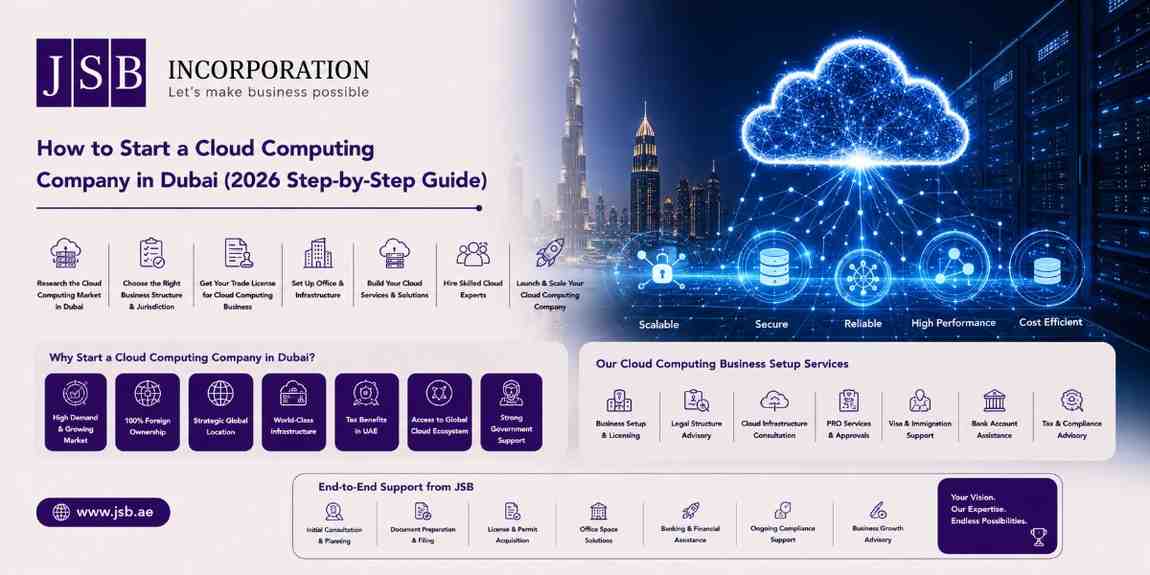
This is your complete, step-by-step guide to registering a cloud computing company in Dubai in 2026, with verified costs, jurisdiction guidance, regulatory checkpoints, and tax obligations.
TDRA, the Telecommunications and Digital Government Regulatory Authority, governs cloud infrastructure and digital government services across the UAE at the federal level.
Its federal cloud network, FEDnet, is actively onboarding government entities, with MoHRE completing a full transfer to TDRA’s cloud infrastructure in 2025.
This creates a direct institutional pipeline for cloud service providers operating locally.
The UAE’s National Cloud Security Policy 2023 establishes clear principles for secure cloud delivery and requires that specific government and sensitive data categories be hosted on UAE-resident infrastructure.
That requirement creates built-in structural demand for locally incorporated cloud companies, particularly those offering sovereign or government-grade cloud services.
You don’t need a local Emirati partner or sponsor to own your company. All UAE free zones permit 100% foreign ownership. On the mainland, 100% foreign ownership is available for most commercial activities following the UAE government’s amendment to the Commercial Companies Law.
Under Federal Decree-Law No. 20 of 2025, effective 14 October 2025, Article 9 now expressly specifies that any company incorporated in a UAE free zone carries UAE nationality. This matters if you plan to pursue UAE government contracts.
Your business falls under the ICT/Technology category. Depending on what your company actually does, you’ll apply for either a Professional (Service and Consultancy) license or a Commercial (Trading) license.
The types of cloud-related activities you can typically register under include:
Activity codes change, and availability varies by free zone. Always verify your specific activities with your chosen free zone’s official portal before submitting. Don’t rely on any third-party list when you’re ready to apply.
Most standard cloud activities don’t need ministry pre-approval before registration.
If you’re offering telecom-integrated cloud services or want designation as a UAE government cloud provider, you’ll need TDRA pre-approval first. TDRA also maintains a voluntary Cloud Service Provider Information Form for providers engaging with the UAE market, accessible via UAE Pass.
This choice determines your tax structure, client access, and setup timeline. Choose a free zone if your model is SaaS, cloud consultancy, managed services, or cloud security targeting international clients. You’ll get 0% corporate tax on qualifying export revenue, faster incorporation, lower startup costs, and 100% ownership.
Choose the mainland if your primary clients are UAE government entities or large UAE enterprises, if you’re building a physical data center or telecom-integrated service, or if you need unrestricted UAE market access from day one.
The first is the dual-license regime. Federal Decree-Law No. 20 of 2025, effective 14 October 2025, revised Articles 3 and 5 to codify that free zone companies, including ADGM and DIFC entities, may establish branches and representative offices on the mainland, with the CCL expressly applying to their onshore presence. Starting in a free zone no longer locks you out of mainland expansion later.
The second is re-domiciliation, introduced through new Article 15 bis. You can now transfer your company’s registration between free zones, between emirates, or from a free zone to the mainland and vice versa, without losing your legal personality or business continuity. Implementing regulations are still being finalized.
Factor | Free Zone | Mainland |
Foreign ownership | 100% | 100% (post-CCL reforms) |
Corporate tax on qualifying income | 0% on exports and FZ-to-FZ | 9% on all income |
UAE market access | International + via branch | Unrestricted |
Setup speed | Faster | Moderate |
Government contracts | Limited (improving post-2025 CCL) | Full access |
Best for | SaaS, cloud consultancy, managed services | Data centers, telecom cloud, government work |
The UAE has 40+ free zones. IFZA, the International Free Zone Authority, is located at Dubai Digital Park, Dubai Silicon Oasis, and is one of the most cost-efficient options for cloud and SaaS companies in 2026. You can hold up to 7 business activities per license, with 3 included at no extra cost.
Under the current 2026 promotion, the Cross Business Activity Fee of AED 2,000 is fully waived for new applications and the next three renewals, so you can combine professional and commercial activities under one license at no extra cost. Always confirm that your specific cloud or SaaS activity is available at IFZA before you apply.
Other free zones with ICT license categories include Dubai Internet City, Dubai Silicon Oasis Authority, and DMCC. Pricing and available activities differ by authority, so always verify from each official portal before making your final decision.
Before you pick a jurisdiction or fill out any forms, get specific about what your company does. Are you a SaaS platform, a managed cloud provider, a cloud security consultancy, or a data center operator? Your model determines your license type, whether TDRA pre-approval applies, and which free zone is the right fit.
Use the official guidance to compare free zone and mainland options.
Your company name must follow UAE naming conventions: no religious or political terms, no duplication of an existing registered name, and no offensive language. Name reservation is done through your chosen free zone’s portal or the DED portal for mainland setups.
Standard documents include passport copies of all shareholders, proof of residential address, your proposed trade name, and selected business activities. At IFZA, the Name Reservation/Pre-Approval Fee is AED 500 per shareholder, deducted from your final license price.
If you want to lock in 2026 pricing while completing your setup, the Lock and Secure downpayment is AED 5,000, deducted from your final fee if you proceed and non-refundable if you don’t.
For standard SaaS, managed cloud, or cloud consultancy, you won’t need additional ministry approvals at this stage.
If your services involve telecom integration or you want to serve as a UAE government-designated cloud provider, TDRA approval is required before launch.
If you’ll be handling data for government clients, check which categories must be hosted on UAE-resident infrastructure under the National Cloud Security Policy 2023.
Under IFZA’s 2026 promotion, all new licenses include a free FlexiDesk for Year 1: 1 desk for Zero and 1-Visa packages, 2 desks for 2-Visa packages, and 3 desks for 3-Visa packages.
FlexiDesks are available during business hours only, with prior booking required and subject to availability. For physical office options, verify current availability and pricing.
All IFZA packages with 1 or more visa allocations include 1 free lifetime residence visa under the 2026 promotion, meaning the standard AED 3,750 DNRD issuance and renewal fee is waived for as long as your license stays active. If DNRD increases its fee above AED 3,750 in the future, you cover the difference.
Budget separately for the items below, because the free visa does not cover these:
If you’re planning to apply for a UAE Golden Visa as a business owner, IFZA issues a NOC for AED 1,250.
All UAE banks are regulated by the Central Bank of the UAE. Tech and cloud companies go through thorough KYC due diligence, so prepare a complete documentation pack before approaching any bank.
To open your business bank account, you’ll typically need your trade license, a business plan, a description of your cloud services and delivery model, shareholder passports and proof of address, your office lease, and evidence of technical operations or existing client engagements.
IFZA business setup figures below are verified from official IFZA documents: the April 2026 price list and the February 2026 Schedule of Fees.
Cost Item | Amount (AED) |
Zero Visa License, 1 year | 11,900 incl. VAT |
1-Visa License, 1 year | 14,900 + 1 free lifetime visa |
2-Visa License, 1 year | 16,900 + 1 free lifetime visa |
3-Visa License, 1 year | 18,900 + 1 free lifetime visa |
4+ Visa License, 1 year | 20,900 + 1 free lifetime visa |
2-year package, 15% discount | 20,200 (Zero Visa) |
3-year package, 20% discount | 28,600 (Zero Visa) |
5-year package, 30% discount | 41,700 (Zero Visa) |
Extra activity beyond 3 included, max 7 | 1,000 each |
Cross Business Activity Fee | 2,000 (waived under 2026 promo) |
Name Reservation/Pre-Approval | 500 per shareholder |
Lock and Secure Downpayment | 5,000 (deducted from final fee) |
Establishment Card, initial | 2,000 |
Establishment Card, renewal | 2,200 |
UAE Residence Visa, 2-year validity | 3,750 |
Investor/Partner Visa Add-On | 1,000 each |
Late renewal penalty | 1,000 + 1,000/month thereafter |
NOC for Golden Visa | 1,250 |
FlexiDesk, Year 1 | Free under 2026 promo |
Pricing Disclaimer: Always verify current pricing with relevant UAE government portals before committing to any financial decision.
UAE Corporate Tax at 9% applies to adjusted taxable income above AED 375,000, effective from June 2023.
If your free zone cloud company qualifies as a Qualifying Free Zone Person under the UAE Corporate Tax Law, you pay 0% corporate tax on qualifying income covering international exports and free zone-to-free zone transactions, provided you meet economic substance requirements. Non-qualifying income, including mainland sales, is taxed at 9%.
Small Business Relief at 0% is available if your annual revenue is AED 3 million or below, but only for tax periods ending on or before 31 December 2026. Corporate tax registration is mandatory for all UAE entities regardless of income level.
VAT at 5% applies to cloud and SaaS services you supply to UAE customers. Mandatory VAT registration starts at AED 375,000 in annual taxable supplies.
Voluntary registration from AED 187,500 is worth considering early if you want to recover input VAT on servers, hosting fees, and software tools.
If you’re a non-resident digital service provider selling B2C into the UAE, you must register immediately with no threshold.
Four rule changes under Federal Decree-Laws No. 16 and 17 of 2025, effective 1 January 2026, directly affect your cloud business:
Tax Disclaimer: Corporate tax and VAT rules are set by the UAE Federal Tax Authority and Ministry of Finance. Always verify current rates, thresholds, and qualification criteria before filing or structuring your business.
Yes, and you don’t need a local partner or sponsor. Every UAE free zone permits 100% foreign ownership. On the mainland, 100% foreign ownership is available for most commercial activities following the UAE government’s amendment to the Commercial Companies Law.
2. Do I need TDRA approval to launch a cloud company in Dubai?
Not for standard activities like SaaS, managed cloud services, or cloud consultancy. TDRA pre-approval is only required if you’re offering telecom-integrated cloud services or seeking designation as a UAE government-designated cloud provider.
3. How much does it cost to start a cloud company in Dubai in 2026?
At IFZA, a Zero Visa License starts at AED 11,900 per year inclusive of VAT, as verified for 2026. Add the Establishment Card initial fee of AED 2,000 and AED 3,750 per UAE Residence Visa if you need residency.
Multi-year packages give you 15% off for 2 years, 20% off for 3 years, and 30% off for 5 years.
4. Can a Dubai free zone cloud company serve UAE mainland clients?
Yes. Federal Decree-Law No. 20 of 2025, Articles 3 and 5, codify that free zone companies may establish onshore branches to serve mainland clients directly.
5. What taxes does my cloud company pay in Dubai in 2026?
As a qualifying free zone company, you pay 0% corporate tax on qualifying income such as international exports and 9% on non-qualifying income like mainland sales.
VAT at 5% applies to UAE-supplied cloud and SaaS services. The January 2026 changes under Federal Decrees-Laws No. 16 and 17 of 2025 updated reverse charge procedures, input tax rules, and VAT refund timelines.
Setting up your cloud computing company in Dubai is achievable in a matter of weeks when you follow the right sequence.
Choose the jurisdiction that fits your model, confirm your activity codes, handle the relevant regulatory clearances, and build your compliance structure correctly from day one.
The market opportunity is real, the legal framework is solid, and the cost to get started is lower than most tech founders expect.
Book your free consultation call today with the experts of JSB Incorporation to learn more.
Also Read:
18 Common Business Setup Mistakes in Dubai and How to Avoid Them
UAE Business Setup and Golden Visa in 2026: A Comprehensive Analysis
How Long Does Business Setup Take in UAE in 2026? (Per Jurisdiction) Breakdown)
The Ultimate Comparison: Business Setup in IFZA Free Zone vs. Mainland Dubai

Office 2505, 25th Floor, Regal Tower, Business Bay, Dubai, UAE P.O Box 27614.
+971 4 824 4842
info@jsbincorporation.com