
 Gaurav Keswani
Key Highlights
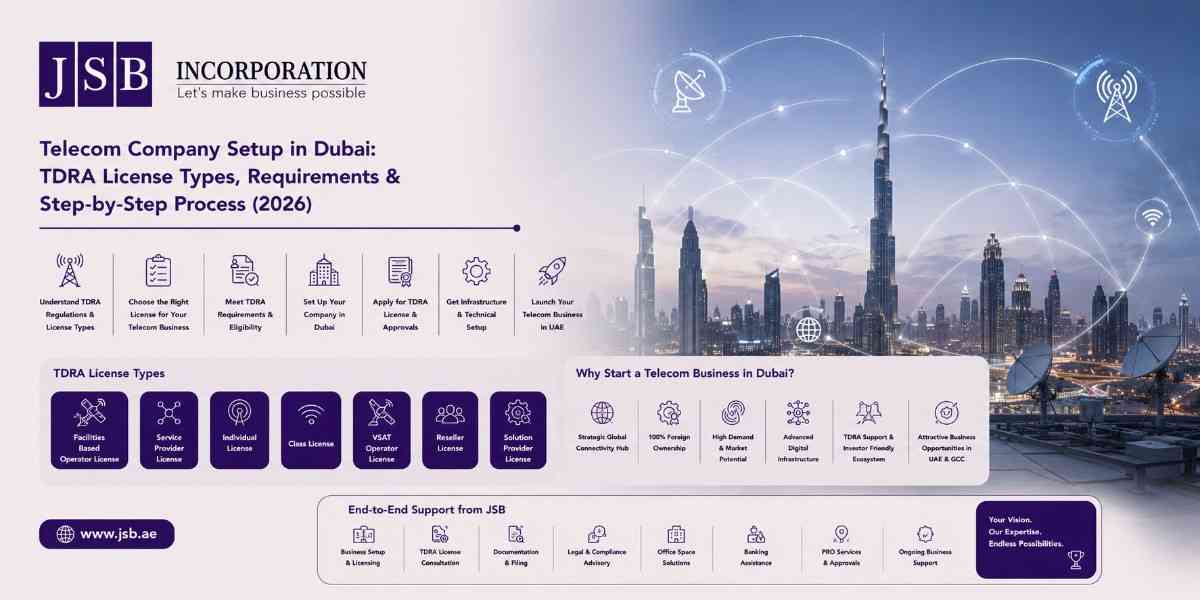
Setting up a telecom company in Dubai requires a license from the Telecommunications and Digital Government Regulatory Authority (TDRA), and whether you need an Individual License or a Class License depends on your ownership structure, the services you plan to offer, and your chosen jurisdiction.
This article covers everything: license types, eligibility rules, required documents, jurisdiction choice, costs, a step-by-step setup process, and answers to the most common questions founders ask before they begin.
TDRA issues two license types: the Individual License for public network operators and the Class License for specialized and value-added telecom services, and the vast majority of new foreign-owned businesses in Dubai will apply for a Class License.
According to the official TDRA service portal, operating a public telecommunications network or providing subscribers with telecommunications services requires obtaining a license from TDRA. The same portal also covers existing licensees who want to renew, amend, or cancel their telecom services license.
Here is the core distinction you need to understand. The two categories refer only to whether scarce resources, specifically spectrum frequencies or numbering, are required.
This is not about how open or exclusive the license is. Both license types are issued individually to legal entities meeting the requirements of the Telecommunications Law, and both require a decision by the TDRA Board.
Feature | Individual License | Class License |
Who it’s for | Public telecom network operators | VoIP, ISP, IoT, satellite, cloud comms, value-added services |
Scarce resources | Requires spectrum or number allocation | No scarce resources required |
Foreign ownership | Max 49% (Board exception possible) | 100% via UAE free zone entity |
Selection process | Competitive: auction, sealed bid, or merit evaluation | Standardized application |
Application fee | AED 10,000 | AED 10,000 |
Complexity | Complex Service (TDRA classification) | Complex Service (TDRA classification) |
The 49% foreign ownership cap on Individual Licenses is the detail that reshapes your entire plan. Unless the TDRA Board explicitly grants an exception, you cannot hold more than 49% of the entity applying for an Individual License.
TDRA may also use competitive selection processes, including auctions and sealed bids, for Individual Licenses. For the Class License route, a 100% foreign-owned free zone entity is eligible.
Disclaimer: License category eligibility and ownership rules are subject to TDRA Board decisions and applicable UAE legislation.
When you’re setting up a telecom company in Dubai, you can choose between a mainland entity via Dubai Economy and Tourism (DET) or a free zone entity. Both require a separate TDRA license, but they differ significantly in ownership rules, office requirements, and your access to the UAE market.
Factor | Mainland (DET) | Free Zone (e.g., IFZA, Dubai Silicon Oasis) |
Foreign ownership | 100% in most commercial activities | 100% |
Office requirement | Physical office mandatory; lease registered with Ejari (Dubai) | FlexiDesk available. IFZA includes free FlexiDesks in Year 1 of 2026 packages |
TDRA approval | Mandatory additional approval | Mandatory, applied separately to free zone trade license |
UAE mainland market access | Direct | Free zone-to-mainland permit required |
Free zone license cost (2026 promo) | Verify at investindubai.gov.ae | From AED 11,900/year, IFZA Zero Visa (April 2026 promotional pricing, incl. VAT) |
Governing law | Federal Decree-Law No. 32 of 2021 (amended Oct 2025) | Free zone authority rules plus CCL Amendment 2025 |
There’s a meaningful regulatory update from late 2025 that changes the free zone calculus. Under Federal Decree-Law No. 20 of 2025, effective 14 October 2025, free zone companies may establish mainland branches if the free zone’s own legislation permits.
This means a single entity can potentially serve both free zone and mainland clients without forming a completely separate onshore company. If you want free zone cost efficiency but eventual mainland market access, understand this before you decide on your structure.
For tech and telecom specifically, Dubai Internet City, Dubai Silicon Oasis, and DMCC are the most commonly referenced free zones. IFZA, located within Dubai Silicon Oasis, is one of the most cost-competitive entry options in 2026.
Disclaimer: IFZA pricing is from the April 2026 promotional price list, applicable to licenses incorporated in April 2026 and their next three renewals.
To be eligible for a TDRA telecom license, your company must be incorporated under UAE Commercial Companies or Business Law, your shareholders must comply with the relevant TDRA resolution, and you must submit a business plan, corporate documents, and financial feasibility evidence, all via the TDRA website.
The TDRA service portal lists the following requirements:
If you’re applying for a Class License through a 100% foreign-owned free zone entity, confirm your specific eligibility in writing with TDRA or a qualified UAE telecom regulatory advisor before filing.
TDRA classifies telecom licensing as a “Complex Service.” The processing time “cannot be estimated, as it depends on security inputs and approvals from third parties.”
That is the official language from the TDRA portal. Build flexibility into your launch planning from the start.
Setting up a telecom company in Dubai runs on two parallel tracks: securing a UAE trade license (mainland or free zone) and obtaining TDRA approval, and both must be completed before the business can legally operate.
Step 1: Identify your telecom business activity.
Determine if your service requires scarce resources (spectrum or numbers). If yes, you’re looking at an Individual License. If not, apply for a Class License. This single decision shapes your entire ownership structure and setup path.
Step 2: Select your legal form.
Mainland options include LLC, PJSC, or PrJSC. For free zones, the entity type is set by the relevant free zone authority. Your legal form must match your business activity under the UAE Commercial Companies Law.
Step 3: Apply for your trade license.
Mainland goes through Dubai Economy and Tourism (DET) in Dubai. Free zone goes directly to the relevant authority, such as IFZA at Dubai Silicon Oasis.
Step 4: Register your trade name.
Through Dubai Economy and Tourism (DET) for mainland Dubai, or the relevant free zone authority. Your name must comply with UAE trade name provisions and cannot already be in use.
Step 5: Obtain initial approval.
The government confirms no objection to your company’s establishment. This does not grant authority to operate. It’s a prerequisite to proceed, nothing more.
Step 6: Draft and attest your MOA/AOA.
Required for LLC, PJSC, and PrJSC structures.
Step 7: Select and register your business location.
Mainland Dubai requires a physical office with an Ejari-registered lease. Free zone setups can use a FlexiDesk. IFZA’s 2026 promotional packages include free FlexiDesks in Year 1 for zero to three-visa allocations, subject to availability and prior booking.
Step 8: Apply for your TDRA license.
Submit your full application package via the TDRA website. The application fee is AED 10,000. The timeline cannot be estimated, as TDRA classifies this as a Complex Service. Prepare every document thoroughly before submitting.
Step 9: Collect your trade license.
After all approvals, including TDRA clearance, are confirmed. Payment is due within 30 days of receiving the payment voucher.
Step 10: Register employees and activate WPS.
The Wages Protection System is mandatory for all UAE businesses. This step is required before you can legally onboard any staff.
The minimum cost to set up a telecom company in Dubai includes a TDRA application fee of AED 10,000 plus a UAE trade license fee, and for free zone setups, IFZA Dubai Silicon Oasis offers one of the most cost-competitive entry points in 2026.
Cost Component | Amount | Source |
TDRA license application fee | AED 10,000 | tdra.gov.ae (verified) |
IFZA Zero Visa License, 1 year | AED 11,900 incl. VAT | IFZA April 2026 promotional price list |
IFZA 1-Visa License, 1 year | AED 14,900 incl. VAT | IFZA April 2026 promotional price list |
IFZA 2-Visa License, 1 year | AED 16,900 incl. VAT | IFZA April 2026 promotional price list |
IFZA Establishment Card, initial | AED 2,000 | IFZA Schedule of Fees, Feb 2026 |
UAE Residence Visa, 2 years (IFZA) | AED 3,750, waived on 1+ visa packages under promo | IFZA Schedule of Fees, Feb 2026 |
FlexiDesk, Year 1 (IFZA) | Free under eligible 2026 promo packages | IFZA April 2026 promotional price list |
IFZA multi-year discounts | 15% (2-yr), 20% (3-yr), 30% (5-yr) | IFZA April 2026 promotional price list |
DET mainland commercial license | Verify at investindubai.gov.ae | investindubai.gov.ae |
Two additional IFZA fees worth factoring in: Establishment Card renewal is AED 2,200 per year, and late license renewal carries a penalty of AED 1,000 per month after the initial grace period.
Q1: Can a foreigner own 100% of a telecom company in Dubai?
Yes, for a TDRA Class License through a UAE free zone entity. For an Individual License, foreign shareholders cannot exceed 49% unless the TDRA Board grants a specific exception.
The TDRA portal states verbatim: “Unless otherwise approved by the Board, the percentage of foreign shareholders in the relevant entity shall not exceed 49%.”
Q2: What is the difference between a TDRA Individual License and a Class License?
An Individual License is for public telecom network operators and requires allocation of scarce resources, specifically spectrum or numbering.
A Class License covers specialized and value-added services, including VoIP, ISP, IoT, satellite, and cloud communications, with no scarce resource requirements. As a new foreign-owned business in Dubai, you’ll almost certainly apply for a Class License.
Q3: Do I still need a TDRA license if my company is in a free zone?
Yes. A free zone trade license and a TDRA license are two completely separate requirements. Both are mandatory regardless of whether your company is in a free zone or on the mainland. There are no exemptions for free zone entities on this point.
Q4: Is VoIP legal in the UAE, and can I start a VoIP business in Dubai?
VoIP services are a licensable activity in the UAE under the TDRA regulatory framework. Only TDRA-approved operators can legally offer VoIP services, and many consumer platforms, including WhatsApp Calls, Skype, FaceTime, and Viber, are restricted.
If you’re building B2B VoIP infrastructure or a communications platform, you need a TDRA license before you go live.
Q5: What documents does TDRA require for a telecom license?
TDRA requires proof of eligibility, certified copies of your AOA and MOA, your full shareholder ownership structure, management team qualifications, a detailed business plan with network diagrams and financial feasibility studies, and, if you’re offering satellite services, a no-objection letter from the UAE Space Agency.
The complete seven-point list is covered in the eligibility and documents section above.
Q6: How much does it cost to get a telecom license in Dubai?
The TDRA application fee is AED 10,000, as confirmed on the official TDRA service page.
This is separate from your UAE trade license cost. Additional licensing fees specific to activity categories are published in the TDRA Licensing Fees schedule.
Q7: Can a Dubai free zone telecom company serve mainland clients?
Traditionally, you’d need a free zone-to-mainland permit or a separate mainland entity. Under Federal Decree-Law No. 20 of 2025, effective October 2025, free zone companies can now establish mainland branches without forming a new onshore company if the free zone’s own legislation permits it.
Consult a qualified UAE business setup advisor to confirm whether this applies to your specific telecom activity and free zone.
The Individual versus Class license decision is the single most consequential choice in your entire telecom setup process. It determines your ownership structure, your application pathway, and your practical timeline to market.
The two-track setup process, trade license plus TDRA license, is non-negotiable. Both must be in place before you can legally operate.
TDRA classifies telecom licensing as a Complex Service with no fixed processing timeline, so starting early and preparing every document before you submit isn’t optional. It’s the only way to avoid costly delays.
If you want to get this right the first time, work with advisors who understand both the regulatory and commercial sides of UAE telecom before you incorporate.
Book your free consultation call today with the experts of JSB Incorporation to learn more.
Also Read:
18 Common Business Setup Mistakes in Dubai and How to Avoid Them
UAE Business Setup and Golden Visa in 2026: A Comprehensive Analysis
How Long Does Business Setup Take in UAE in 2026? (Per Jurisdiction) Breakdown)
The Ultimate Comparison: Business Setup in IFZA Free Zone vs. Mainland Dubai

Office 2505, 25th Floor, Regal Tower, Business Bay, Dubai, UAE P.O Box 27614.
+971 4 824 4842
info@jsbincorporation.com